Showing posts with label film. Show all posts

Tuesday, 7 October 2014

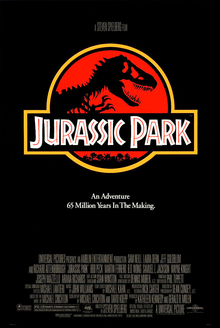
Watch with Stew: Jurassic Park (1993)


00:00:00               Jurassic Park (Steven Spielberg, 1993) remains the most successful dinosaur movie ever.  The logo, the core idea (of cloning dinosaurs to put them in a zoo) and some of the dialogue, as well as the dinosaurs themselves are imbedded in the popular consciousness.  With the fourth film, Jurassic World coming next summer, I thought I’d take a look at the original.  Now, I know Jurassic Park isn’t scientifically accurate.  Both intentionally and accidently the dinosaurs differ from what you’ll find in modern scientific texts.  But, scientific accuracy is a moving goalpost and not the purpose of a mainstream movie, so I shan’t dwell on that.

I remember this coming out in 1993 and being desperate to see it.  For reasons I can’t recall I got given Michael Crichton’s book and was told I couldn’t see the film until I’d read the book, which I did.  As much as I love it, my view of it the film has always been coloured that.  I won’t say that one is better than the other; they’re very different beasts.

00:00:52               The film opens with this sequence where a mystery animal in a crate is being transported to a high security pen.  It serves to create suspense and also ties in with the end of the film where the animals in question escape.  All three Jurassic Park films have used this opening scene to tease the island and the dinosaurs on it – in the second one it’s the little girl and the Compsognathus and in the third one you don’t actually see the dinosaurs, but something kills the crew of the speed boat.

00:01:08               First Jurassic Park logo.  This film loves reminding you what you’re watching.  There must be a drinking game where you drink each time you see the park logo.  Actually, forget you read that.  Always drink responsibly.

00:01:15               Here’s the late Bob Peck as Robert Muldoon, the park’s game warden.  This is one of his best scenes, as in the middle act of the film he has some really clunky dialogue to contend with – “We should’ve had locking mechanisms on the vehicle doors!”

00:01:49               Here’s the graphic letting us know where we are.  On the Blu-ray version I’m watching it says “Isla Nublar 120 miles west of Costa Rica”.  These look like they’ve been redone for high-definition and I’m sure that my old DVD and the original theatrical version said “Isla Nublar 120 miles of Costa Rica”.  If anyone can substantiate, please leave a comment below.

00:02:21               Peck’s delivery here is wonderfully weary. “Loading team, step away.”  It’s almost “Do I have to talk you through this every time?”  It suggests this is something that should be routine by now but these idiots in overalls keep making mistakes.

00:02:44               Not sure why the cage rolls backwards.  It seems like someone forgot to lock something down.  Muldoon didn’t say “Now lock the thing” so maybe it didn’t get done.  Still the whole bit with the cattle prods is great.  Shame they don’t reappear later in the film.

00:03:33               Martin Ferrero as Donald Gennaro or "Exposition Man", which is the primary function of this character.  Here he’s visiting a mine to deliver some exposition.  This amber mine is called Mano de Dios – Hand of God.  Now I’m not from the Dominican Republic so I don’t know how they feel about amber, but that seems like a rather grandiose name for a place where a semi-precious rock is dug out of the ground.

00:04:40               Gennaro should have concussed himself or at least have a bruise from the bang when he hits his head.  It would’ve been sort of funny for him to have a bandage on his head before they even get to the dinosaurs.

00:05:07               This shot of everyone looking at the amber with the mosquito entombed inside has a very Indiana Jones feel.  The way they gather round and the torchlight and the vocals on the soundtrack give the impression of having found an ancient relic with strange powers.

00:05:22               The scene at the dig in Montana.  The velociraptor claw being unearthed is a different colour to the rest of the skeleton and also to the rock the fossil is embedded in.

00:06:17               The sonar machine that maps the skeleton by shooting sound waves into the ground might be based on real science although I’m sure they’d dig them up.  I think it’s based on fact, but I’m not sure.  Google it.

00:07:03               Alan Grant (Sam Neill)’s techno-phobia is an interesting idea but it’s so heavy handed that it detracts from his character rather than adding nuance to it.

00:07:15               Grant suggests an evolutionary connection between dinosaurs and birds.  This is probably the first time this was said in mainstream media.  However raptor doesn’t mean “bird of prey” in taxonomy, it means “thief”.

00:07:36               “More like a 6 foot turkey.” Grant’s description of raptors hunting is wonderfully gruesome.  I didn’t notice, until I watched the film for this commentary, the vulture noises on this sequence.

00:09:11               Why does Grant hate kids?  Between this and his inability to operate machines, he seems like a bit of an arsehole for the first half of this film.  This is a particular problem as he’s our point of view character.  It’s an ensemble cast, but he’s the one we spend most time with.  We need to relate to him, but these two facets of Grant make him a caricature.  Another issue is that Ellie (Laura Dern) and Grant have very little chemistry.  Clearly they are meant to be a couple as at some point they must’ve had a conversation about starting a family.  But there’s no warmth here and I don’t believe Ellie and Grant ever even got off.

00:10:20               Enter the late great Richard Attenborough as John Hammond.  This Hammond is a much jollier and more likeable character than in the original novel.  The book’s Hammond is a cynical capitalist and seems to be on bad terms with all his employees.  I think this different take on the character was due to Spielberg casting Attenborough.

00:11:26               I said I wasn’t going to dwell on scientific inaccuracies but this is something I’ve not seen picked up on before.  Hammond says that he’s spent 5 years setting up the preserve in Costa Rica.  But when they get there all the dinosaurs in the park are adult sized.  Perhaps we know more about dinosaur growth rates than we did in 1993, but logically after hatching from an ostrich egg, a brachiosaurus could not reach a length of 22 metres in just 5 years.  That’s a growth speed of over four metres a year, not to mention an expediential increase in weight.  Perhaps the scientists developed accelerated growth or something to get round that problem.

00:13:11               Hammond convinces Ellie and Grant to come to the island less than three minutes after they’ve met him.  Obviously they need to go in order for the film to continue, but they’ve only just met and he doesn’t tell them what’s on the island.  Also I’d question whether getting funding for their branch of science is so hard that need to take this kind of dubious offer.

00:13:19               The Dodgson - Nedry scene; it’s not made crystal clear here, but Lewis Dodgson is an high ranking executive in a rival genetic company called Biosyn and is paying Nedry to steal the embryos from Jurassic Park so his company can reverse engineer them and create their own dinosaurs.  He is the main antagonist in Michael Crichton’s The Lost World: Jurassic Park novel.  You can get an overview of this character here; http://jurassicpark.wikia.com/wiki/Lewis_Dodgson.

This scene, which was very obviously filmed in Hawaii, shows waves crashing in the background but San Jose, Costa Rica is actually nowhere near the sea.  When the film was shown in Costa Rica, this graphic was removed.

00:13:38               Wayne Knight is great as Denis Nedry.  You really buy him as a disgruntled employee and this scene perfectly sets up his story.

00:15:18               Hammond tells Ellie and Grant that he has a jet at Choteau (a city in Montana) but it does look like they’ve taken this little helicopter all the way from Montana to Isla Nublar, i.e. the entire length of the US and central America.

00:15:32               Jeff Goldblum as Ian Malcolm steals most of the scenes he’s in, particularly in this first hour.  All the chaos theory stuff serves to foreshadow what’s going to happen later on.  There’s so much more chemistry between Laura Dern and Goldblum than between her and Sam Neill.  Which wouldn’t be an issue where it not for the fact that Ellie and Grant are apparently discussing starting a family.

00:16:35               Hammond points out the window and says “There it is” but he appears to be sitting facing the back of the helicopter so wouldn’t be able to see the island.

00:17:24               The bit where Grant ties two seatbelts together is dreadful.  Not being au fait with computers is one thing, but not being able to do up a seatbelt is ridiculous.  We’ve established he’s not technology-minded but this makes him look like an idiot.  Also by tying two seat belt ends together not only has he endangered himself in the event of a crash, but left Ellie with no protection at all.  Why would she want to have kids with this guy?

00:18:19               There’s a distractingly large dent in the helicopter door as Hammond etc. are getting out.

00:18:43               Why does the helicopter leave?  Considering the potential risks on the island and apparent lack of medical facilities, they should have a helicopter or some other means of reaching the outside world on hand at all times.  It would certainly save a lot of bother later on.

00:20:10               Ellie is examining a leaf from a species of plant that became extinct in the cretaceous period.  The shot where she picks it was in the trailers but isn’t in the film.  How did they recreate extinct plants?  This is never explained.

00:20:20               Our first full shot of a dinosaur!  The special effects in this film still stand up, even after 20 plus years.  The brachiosaurus in these shots actually looks better than the ones in Jurassic Park 3, which are sluggish, flabby and camouflaged, which makes no sense for the 22 metre long, 35 tonne animal – where’s it going to hide?  Anyway back to this film.  These first shots of the brachiosaurus are great and in 1993 they just blew everyone’s mind.  It really felt like looking at a living dinosaur.  Ellie and Grant’s reaction is interesting; immediately debunking outdated assertions about dinosaurs; “this is a warm-blooded animal” and so on.

00:21:32               From seeing the brachiosaurus, Gennaro starts talking about how much money they’ll make.  As a lawyer representing companies or individuals that have invested in Jurassic Park, it’s not clear how he stands to profit from its success.  This is the result of two factors.  The first is Hollywood’s tendency to present lawyers as money-grabbing bastards.  The second is that in the novel and early drafts of the script there was a character called Ed Regis, the park’s PR manager.  In the novel it’s he who pees his pants and runs just before the T. rex escapes.  Seems the characters of Gennaro and Regis were merged, leaving the lawyer with some lines that sound a bit like he’s working for Hammond.

00:21:42               “We have a t. rex!” This is an odd way to introduce the idea of the tyrannosaurus rex being in the park.  It has nothing to do with what they’re talking about and it would have been more of a surprise if saved until they were on the tour.  They say T. rex so many times in this film, I think it popularised the use of the term, in the UK at least.

00:22:13               The wading brachiosaurus in the long shot don’t have any water running off them as they come out of the lake.

00:23:37               The out of a job/ don’t you mean extinct? Exchange is based on something stop-motion effects veteran Phil Tippet said when he saw the first CGI dinosaur test shots and Spielberg had it put into the script.

00:24:02               Would Hammond really have done this acting to the screen every time the film was shown once the park opened?

00:24:53               The Mr DNA film expertly dresses up a lot of exposition in a nice package and in a way that perfectly fits with the context of the film.

00:28:10               As they enter the lab we hear Ray Arnold (Samuel L. Jackson) over the tannoy reminding everyone to be on time for the boat.  But why is everyone going home for the weekend?  Plot wise, it reduces the cast to the core characters (something they didn’t bother to do in the sequel) but realistically there should be more people on this island; they’re trying to get the place ready to open and this is the first time the park’s had visitors.  Not only is there the safety issue, there’s also the issue of providing food and room service.

00:28:14               B.D. Wong as Henry Wu.  Like many of the supporting characters, Wu has a much larger role in the novel.  Amongst other things, he argues for engineering more docile versions of some of the dinosaurs.

00:29:21               So here’s our second dinosaur; the hatching baby raptor.  It never blinks.

00:29:39               Malcolm and Wu talk about the dinosaurs breeding.  Again looking at the novel, the issue of the dinosaurs reproducing is much more significant.  There are three conditions for maintaining control of the island; keeping the dinosaurs in their cages, keeping them on the island and preventing them from breeding.  In the book all three of these fail pretty early on.  It might have been nice to have this framework in the film, thus adding a few more threads to the plot.  Once the systems are back online, they could have contacted the boat to get it to turn around, thus delaying the characters’ escape from the control room.

00:31:41               The raptor pen.  I like this location and the way its look contrasts with the white walls and smooth lines of the Visitor Centre.  But if they bred 8 raptors originally, surely this pen is too small; no wonder they were trying to escape.  This is also the first of many enclosures with far too much vegetation - more on that later.

00:32:52               Enter Muldoon.  All this talking about the raptors feels like overkill.  So it’s saying dinosaurs weren’t stupid and that’s a good thing, but the “extreme intelligence” isn’t really born out onscreen.  So they open some doors; cats and dogs can do that.  Also, they don’t need to be this super intelligent ultimate hunter; they just need to be smarter than we think they’re going to be.

00:34:02               The harness that lowered the cow in emerges torn and broken (but not bloodied?) – what a waste of harnesses.

00:34:32               “We can charge anything we like.” – More Ed Regis dialogue from Gennaro.

00:38:08               Enter the kids, Lex (Ariana Richards) and Tim (Joseph Mazzello).  Yes they’re annoying but, as Hammond says, they’re the target audience and actually when they’re not being used very baldly for comic relief they give really good performances.  In the novel the kids’ ages are reversed and Tim is both the dinosaur and computer fanatic.  The 8 year old Lex in the book serves very little purpose.  Here their characters are much better balanced.

00:40:27               The park control room; this is a great set, with the round windows and the fossils in the pillars.  If you watch in the shot where the theatre/ ride revolved to reveal the lab earlier, you can see the control room on the far left.  I imagine that in the full version of the ride Mr. DNA went on to talk about the control room “...where our advanced computer systems keep y’all safe while you’re out in the park” or something.

00:41:42               Malcolm’s line referencing King Kong as they enter the park unnecessarily flagpoles the fact that the gate is based on the one from the 1933 movie.  It’s like they wanted to make sure everyone got that piece of intertextuality, rather than just slipping it into the film quietly.

00:41:57               The tour voice is indeed Richard Kiley, American stage and screen actor who also narrated the Planet Earth documentary series in 1986.  Kiley is the tour voice in the book and it’s nice they got him for the film.

00:43:10               Here we see Nedry on the island and get a bit more of his backstory.  Of all the supporting characters, Nedry is probably the best written.

00:49:01               We see the boat at the east dock.  In the book Tim and Grant see the boat from the tour and see raptors on the deck, leading to a subplot where they have to get the boat to turn around before it reaches the mainland.

00:49:58               50 minutes into the film we see our third dinosaur.  The sick triceratops is the only animatronic dinosaur we see out in the open in broad daylight.  We see it from multiple angles and the actors are touching it and interacting with it.  This takes things to a sense of realism beyond the CGI long shots from earlier and you see the characters getting really taken in too.

00:51:03               Here is Dr Gerry Harding, another supporting character whose part is greatly reduced from the novel.  It’s a shame we don’t get to find out what’s wrong with the triceratops.  Ellie seems to get half way, then the scene stops after the dinosaur poo gag.

00:53:04               The piles of dinosaur poo are ridiculously huge and compacted.  Also I don’t think they check them properly.  This is the beginning of the film’s obsession with dinosaur bodily excretions.

00:54:50               Hammond laments the first tour and here is the problem with this section of the film; the enclosures are so full of plants any dinosaurs would be hidden.  I see why they did this; to build suspense until the fences are shut down and the dinosaurs escape.  Another reason is that in 1993 the effects technology was new, it was expensive and they had to use the shots where it really counted, which is in the second half of the film once the dinosaurs have escaped.  Still, having foliage so dense that a 7 tonne T. rex can disappear, stretches credulity too far.  Maybe they could’ve hinted at the T. rex like with the raptor in the opening sequence or had another herbivore on show just to make for a more plausible zoo experience.

00:55:50               The scene where Grant and Malcolm talk about kids in the car feels so contrived; would you really have that conversation with some you’ve known for a day?  Also Malcolm’s “always looking for a future ex-Mrs Malcolm” line makes him sound like such an arsehole.  All it seems to do is fill in time while Nedry gets to the lab, which is right next door to the control room.

00:57:11               And here Nedry is, stealing the embryos.  He’s told by Dodgson to get all 15 species, but we only see 7 species in the flesh (Brachiosaurus, Parasaurolophus, Velociraptor, Triceratops, Tyrannosaurus, Dilophosaurus and Gallimimus).  In addition we see Proceratosaurus, Metriacanthosaurus and the misspelt “Stegasaurus” embryos being put in the shaving foam container.  It’s not clear what the other 5 species are but you can probably add dinosaurs from the sequel such as Pachycephalosaurus and Compsognathus.

00:59:47               The guy with the pipe on Nedry’s desk is J. Robert Oppenheimer, one of the inventors of the atomic bomb.  A comment on the misuse of scientific power perhaps?

01:00:46               Conversely to their previous scenes, the exchange between Grant and Malcolm when he gets back in the car is good; it feels natural and it’s kind of funny.

01:01:47               As a piece of action, the T. rex attack on the two cars is practically faultless.  The suspense is built brilliantly in elements such as the vibrations in the water glasses and the snapping cables.  The reveal of the rex is awesome too.  Then we see most of the attack from inside the tour cars which makes it so much scarier because it feels like it’s happening to us.  Also with touches like the dinosaur’s breathing and the contracting pupil the rex is much more like a hunting animal than a movie monster.  This is the longest sustained sequence of dinosaur action in the film.

01:09:12               One slight detractor is that the geography of the scene here is confusing or confused.  The T. rex appears to push the wrecked car back through the fence it broke but now there’s a 100 foot chasm behind it, which wasn’t there a few minutes ago.  It’s like we’ve changed location without moving.  This sequence with Lex and Grant below the car is the first of several where characters are in peril that doesn’t directly relate to dinosaurs.

01:09:41               The wrecked car crashes down into the tree.  I’m unconvinced Tim would survive that.

01:12:04               Nedry and the dilophosaurus; this scene plays out brilliantly, with Nedry not recognising the threat from the dinosaur until it’s too late.  The way the sounds change when the dilophosaurus reveals its true nature is wonderful.  The colour and textures on this dinosaur, particularly the one in the car, is slightly reminiscent of the bad gremlins (Gremlins, 1984).  Nedry’s death could have been more gruesome (it certainly is in the novel) but then this film pushed the boundary of what you could show in a PG as it is.

01:14:23               The can of embryos getting covered over with mud feels like a set up for a sequel (it wasn’t).

01:17:53               As the mangled tour car falls through the tree it should be forced away from the trunk by the branches.  The way it’s falling here is a little neat and convenient.  This is another sequence that ups the danger but doesn’t feature a dinosaur.

01:19:26               Malcolm is found under the wreckage of the restroom, but his shirt is undone and he has a tourniquet on his leg.  I don’t think he could’ve done that whilst under the wreckage, so did he cover himself up again?

01:20:53               The T. rex jeep chase sequence; this must’ve been one of the first digital sequences finished for the film because the shot of the jeep smashing through the fallen tree followed by the rex was one of the few shots using CGI in the trailers and TV spots. I recall that there were no CGI images in the pre-publicity for this film, which is hard to imagine when you look at modern summer blockbusters.

01:21:31               For a film with so many special effects, the back projection behind Malcolm really looks bad.

01:23:41               Grant takes the fossilised raptor claw out of his pocket and throws it away.  Surely it would have broken by now?

01:24:51               The gift shop is full of actual film merchandise.  It also has sabre-tooth cat soft toys, which seems a little off message.  Maybe they came mixed in packs with the dinosaur toys.

01:27:30               Why is Ellie so sure the park in unsalvageable?  As far as they know 1 dinosaur has escaped, 1 person has died and 1 is injured.  Alright Grant and the kids are missing but I not sure this warrants writing the whole thing off.

01:28:34               In the book, Grant and the kids spend the night in a maintenance building in the triceratops paddock, which makes sense; seeking refuge in something man-made.  Also they could’ve dressed their injuries, maybe tried to call for help.  A baby triceratops was made for such a scene before it was cut and the action moved to the tree with the brachiosaurus – and the dinosaur snot.  So we’ve had, poo, spit and snot.  Let’s be grateful they stopped there.

01:30:25               Grant finds the egg shells.  So the dinosaurs are breeding.  In the last shot we see tiny raptor footprints leading away from the nest.  So my question is what about the raptors that laid these eggs?  At this point no raptors have escaped that we know about and we’re at least a mile from the raptor pen.  So we find out that some dinosaurs have bred, but it’s not to the point where there’s an unsustainable population explosion. It seems like there was an obligation to keep some elements from the book in the final film, even though they don’t really have any bearing on the story.  Which brings me to…

01:32:23               The lysine contingency; this feels like exposition left from a previous draft of the script.  It serves no function here because it’s not an answer to the current predicament and it’s the only suggestion in the whole film that dinosaurs could leave the island.

01:33:00               Samuel L. Jackson is of course great and it’s a shame he’s in it so little.  I love the line “hold onto your butts” and it would’ve been nice if it has cropped up in the sequels, like a Jurassic Park equivalent of “I have a bad feeling about this.”

01:34:04               The stampede sequence was filmed on the same location as the scene where Indy is chased by the Hovitos in Raiders of the Lost Ark, according to the Making Of book.

01:36:02               Ellie comes down the stairs muttering “something’s happened” and so on.  People talk to themselves a lot in this film.

01:37:58               The raptors have escaped!  If only the three guards we saw earlier hadn’t left for the weekend.

01:41:50               There’s great cross-cutting between Ellie switching the power on and Grant and the kids on the fence.

01:43:10               Tim’s refusal to jump is a bit silly, but not as daft as his being electrocuted which, let’s face it, should almost certainly have killed him.

01:43:48               After condemning the park to Hammond the previous evening, Ellie uses the phrase “back in business” as soon as the power comes back on.  This line feels like it was put in so it could be used in trailers; what you might call ‘trailer fodder’.

01:44:12               Arnold’s arm drops on Ellie’s shoulder, but where’s the rest of him?  Also you wouldn’t get Samuel L. Jackson killed off-screen in a movie now.

01:44:44               Muldoon hunts the raptors; a great scene and one of the only ones where you see a predatory dinosaur essentially doing nothing.  Like the baby, the adult raptors are rather dead eyed.

01:45:30               “Clever girl.” Classic last line.

01:46:53               The Visitor Centre sets are so lavish and detailed.  The murals were inspired by Charles R. Knight’s natural history murals in the Field Museum in Chicago and have a similar blue-green palette.

01:47:11               Here’s a gratuitous shot of Laura Dern’s bum.  She’s limping in this scene but it’s not clear why.  Also her salmon pink shirt has vanished.

01:47:58               After the t. rex attack, the raptors in the kitchen sequence is the standout set piece in the film.  It’s brilliantly paced, suspenseful and dinosaurs in enclosed spaces hadn’t really been done before this.  The unique threat of the raptors, more than their intelligence, is that they can follow you into more places than a bigger dinosaur.  There's also the sense of the unfamiliar in a familiar place, which is always scary.

01:51:59               Raptors can kill grown men but can’t overpower these two children pushing a door? Hmm.

01:52:50               I like that Lex gets the computer system up and running again because it means she achieves something and makes her seem a bit less like baggage.  Not sure what Tim’s doing in this scene though, except possibly trying to rub his tummy and pat his head at the same time.

01:54:42               Why does Hammond yell down the phone not to shoot the raptor?  Would he rather they ate his grandchildren?

01:55:27               When this shot where Lex nearly falls through the ceiling was filmed, the stunt actor looked into the camera, revealing her face.  Ariana Richard’s face was composited into the shot in post-production.

01:56:06               So we get to the finale in the main hall with the dinosaur skeletons which was teased earlier in the film.  The original ending had Grant killing the raptors with a crane, but Spielberg had it rewritten in order to bring the T. rex back, feeling she was the ‘hero’ of the film.  The climax of the film certainly would have felt a little flat without it.

01:57:10               This is the only time the T. rex doesn’t make a sound before striking.  It even manages not to shake the ground.

01:57:44               Now Hammond has given up on his park, but 3 minutes ago he was telling Grant not to shoot the raptor, which suggests he was still thinking it was salvageable.

01:57:58               The T. rex kills the second raptor and destroys its fossil counterpart.  Yay, dinosaurs are great!

01:59:04               There’s this moment where Ellie is looking at Grant and the kids, like he’s now ready to have kids of his own, but because they’re not a very convincing couple to start with it doesn’t quite ring true.  Besides, it’s like she’s saying “because you got these kids back safely, when we get back to Montana we’re going to pork like crazy”, which is creepy.

01:59:33               Not sure what the pelicans flying alongside the helicopter signify.  Is it representing the return to the modern world or is it affirming the bird-like characteristics of the dinosaurs?  Or maybe it’s just a nice peaceful image to end on - who knows?

02:00:08               End credits roll.  There you have it.  So the movie is a much stripped down version of the novel.  The plot is light; look past the scenes explaining the cloning, the amusement park and the disgruntled employee who causes the shut down and you have the plot of nearly every dinosaur flick since The Lost World (1925), i.e. People get trapped in a place where there are dinosaurs and have to escape.  There are some ‘orphaned’ subplot elements that don’t go anywhere and there’s some clunky characterisation too.  These issues could have been ironed out with a bit more script work.  If Jurassic Park was being made now the script might have had that extra polish.  But ultimately none of that matters.  Few people did or ever will come to this movie for real-life human characters or complex plotting.  The aim of this film was to make the most convincing dinosaur film ever.  It did exactly that.  Read any number of recent reference books and you find writers are still correcting preconceptions from this movie.  That’s a powerful endorsement of its success.  For further proof, note that Jurassic Park did not spawn a wave of other dinosaur movies.  Even its sequels (thus far at least) essentially rework the same plot to diminishing returns.  All of which proves it is quintessential and frankly unbeatable.

Wednesday, 11 December 2013

Exploring The Lost World

First published in 1912, The Lost World by Arthur Conan Doyle is generally considered to be the first dinosaur story. The thrilling adventure yarn – familiar to millions – is a true landmark of popular culture. 

Initially serialised in the Strand Magazine, the story is told to us by journalist Edward Malone. In order to win the love of his fiancé, Gladys Hungerford, Malone has agreed to accompany Professor Challenger on an expedition to South America to investigate tales of a plateau where dinosaurs still exist. Together with the sceptical Professor Summerlee and big game hunter Lord John Roxton, they start to find evidence to support Challenger’s theory. Accessing the isolated plateau by climbing a rock pinnacle and felling a tree to form a bridge, they become trapped when the bridge is destroyed by treacherous aids.

As Conan Doyle’s characters explore, they discover numerous prehistoric species that have survived in this isolated corner of the world. The plateau is wondrous but dangerous, roamed by vicious pterodactyls and carnivorous Megalosaurus. The explorers also discover that it is home to a tribe of natives who are at war with a species of primitive humanoid – a form of ‘missing link’ between Homo sapiens and the great apes. The explorers help the natives defeat the ape-men and in doing so win their friendship. Eventually, the chief’s son shows the explorers a way down from the plateau.

When the characters return to London to share their discovery with the scientific community, no-one believes them until they produce a young pterodactyl they have brought back. The creature quickly escapes, causing alarm, but undeniably proving their case. Hailed as heroes, they retire to Lord Roxton’s rooms where he reveals another export from the plateau: diamonds valued at £200,000. With the proceeds from these precious stones, Challenger plans to open his own museum and Summerlee retires to catalogue his fossils. Malone (rejected by Gladys, who has married a solicitor in his absence) and Roxton plan a return expedition to the lost world.

Arthur Conan Doyle had broad-ranging interests: alongside his keen advocacy of spiritualism, he was interested in judicial reform, criminology and palaeontology. His home, Windlesham in Crowborough, East Sussex, was on the Weald – an area of rock formations that date back to the Upper Jurassic (145.5–150.8 million years ago). This contributed to the author’s fascination with prehistoric life and, in the spring of 1909, he wrote to the Natural History Museum requesting an expert come and view what appeared to be Iguanodon tracks found at a nearby quarry. Conan Doyle hand-drew the tracks in his letter and the discovery directly inspired a passage in The Lost World, where the first evidence of Iguanodon on the plateau also takes the form of footprints.

In November 1911, Conan Doyle wrote again to Arthur Smith Woodward, the Museum’s keeper of Geology reporting that ‘we have something in the old quarry that is beyond me’. He claimed that this mysterious object was ‘not an impression but a body’. However, when geologist Charles Dawson was dispatched to examine it, the body proved to be a ‘mere concretion of oxide of iron and sand’. The experts perhaps viewed him as a happy amateur, but Conan Doyle persisted in his hope of finding extinct reptiles in some state other than fossilised. In September 1922, he wrote to Smith Woodward stating he had seen an ichthyosaurus in the Aegean Sea.

Conan Doyle started The Lost World in October 1911 and, for details of the prehistoric life, he referred to Extinct Animals by E Ray Lankester, then Director of the Natural History Museum. This book, described by its author as ‘[nothing] more ambitious than attempt to excite in young people an interest in a most fascinating study’, contained illustrations and descriptions of many species Conan Doyle included in his adventure. However, he interpreted some of the science in peculiar ways. In Extinct Animals an image of an ichthyosaurus skull shows the parietal foramen, a hole which in modern reptiles contains a photoreceptive organ call the parietal eye. The Ichthyosaurus in The Lost World has a visible third eye on top of its head. Also, despite a clear description in Extinct Animals of Megalosaurus as bipedal, Conan Doyle’s animal walks on either two or four legs and resembles a horrible toad.

Conan Doyle may well have been inspired by the model dinosaurs at Crystal Palace Park, opened in 1854. The reconstructions, including a quadruped Megolosaurus, were already deemed obsolete by the 1900s. Like the fictional plateau, the exhibition in Sydenham featured a mixture of species from different time periods, all apparently living together around a lake. From Jurassic and Cretaceous dinosaurs to the much more recent Toxodon and Irish elk, almost all of the species at Crystal Palace appear in Conan Doyle’s book.

Conan Doyle also took an interest in exploration. In 1909 he spoke at a luncheon for Ernest Shackleton and later appeared with Robert Falcon Scott at a fundraiser for the British Antarctic Expedition. The following May he jovially admonishing American explorer Robert Peary for making the job of storytelling much harder. Previously it had been possible to write about remote parts of the world without fear of contradiction. Now that so much of the world had been explored, he asked where ‘the romance-writer is to turn when he wants to draw any vague and not too clearly-defined region’.

The answer apparently lay in the Amazon Basin. At a time when the border between Brazil and Bolivia was poorly defined, Conan Doyle’s close friend Percy Harrison Fawcett led the Bolivian Boundary Commission, tasked with preventing border disputes. When Fawcett returned to England, he brought with him tales of the Huanchaca Plateau and an impenetrable jungle where anything could be hiding.

Conan Doyle knew that exploration had led to the expansion of the British Empire, through the acquisition of new territories. He also recognised that the Empire required defence. Covering a quarter of the globe, and home to 285 million people, it was difficult and expensive to police. Britain’s small professional army was surrounded by the larger, conscripted, armies of her European neighbours: old enemies like France and Russia, and a more recent concern – Germany. The less than glorious victory of the Boer War led to genuine fears that a future conflict might lose Britain her colonies or even her independence. These worries were countered by a brash imperialism that permeated middle and upper classes British culture. In 1907, Robert Baden-Powell set up the Scout Movement to promote health, exercise and teamwork in boys. There wasn’t an implicit military connection, but he stated that they should ‘be a brick’ in the ‘wall of Empire’.

In the years preceding The Lost World, Conan Doyle wrote several Roman-era short stories, as allegories for contemporary British issues. The Last Galley was a fable about Britain’s naval superiority in the face of expanding German sea power. The Lost World’s brash imperialism is evident the admiration heaped on Roxton’s military skills and in the plot’s focus on British explorers aiding natives in defending their territory against an inhuman aggressor. Malone enthuses that, following his adventures on the plateau, he should receive a commission as correspondent in the next Great War.

The Lost World was adapted into a film in 1925 by American film-maker Willis O’Brian, using stop-motion effects to realise the dinosaurs. The movie reduces the book’s militaristic tone by adding a female character to the party and many subsequent adaptations have followed suit, overlooking Edwardian social conventions to add romance to the story. The 1925 movie also removes the conflict between the natives and ape-men, while the belligerent presence on the plateau is reduced to an actor in an ape costume and a chimpanzee. Even the treachery that traps the explorers is replaced by a brontosaurus feeding on the felled tree. Perhaps, after the First World War, the book’s soldierly fervour was considered inappropriate for cinema audiences.

By downplaying the battles between humans and ape-men, the story is refocused on exploration and scientific discovery. Although the original text is arguably diluted, the most exciting element is retained, and even magnified. The notion of an isolated place where prehistoric animals continue to thrive was first explored in Jules Verne’s Journey to the Centre of the Earth, but Conan Doyle was the first novelist to make this a central premise of his work, thus creating the archetypal dinosaur narrative. The narrative has reoccurred frequently since 1912, with tales in which people discover some remote location inhabited by creatures long thought to be extinct, become trapped and must endeavour to escape.  Jurassic Park is essentially The Lost World combined with a fear of modern technology.  At its core is the thrill of the unknown and this tale is an adventure that audiences of all ages can enjoy. As its author stated:
I have wrought my simple plan
If I give one hour of joy
To the boy who’s half a man,
Or the man who’s half a boy.

Friday, 15 February 2013

Viewer's Commentary: Batman (1989)


00:00:00:              Despite being a confirmed Bat-fan, when I was a kid, I wasn’t interested in Batman.  I didn’t like the character or any of his stories.  The reason for this is that the only exposure I had to the character was through repeats of Adam West TV show.  Cultural historians like to claim it was ironic, archly self-aware, even subversive pop art.   But it was unexciting, emotionally empty and formulaic.  Worse still it took arguably the greatest character to come from comic book literature and reduced him to a primary coloured, jobbing idiot.  It was produced at a time when comics weren’t considered anything other than for kids, so it was irreverent and forgettable.  But the main problem was that it wasn’t remotely thrilling.  The title sequence, where an animated Batman and Robin fought a crowd of armed thugs was the most exciting part.

As for a lot of people, this film introduced me to Batman as a dark avenger and a character with a tragic origin and the psychological issues rising from that.  I won’t say this is what Batman should be like, but it was the first time I felt Batman and his world could deliver excitement and intrigue.

00:00:18:              The camera tracks through canyons etched in stone that are revealed to be the Bat insignia.  We also have Danny Elfman’s often derided theme music.  It suits this melodramatic take on the character and this main theme became pretty much definitive for a long time.  It was subsequently used in Batman: The Animated Series.  Check out this with-lyrics version by Goldentusk - http://www.youtube.com/watch?v=wUPBgYeanZ0.


00:02:28:              Is the ‘Gotham City’ caption here really necessary?  We know Batman lives in Gotham City so it’s basically saying ‘this is a Batman movie’.  What have the last 2 ½ minutes been about then?

00:02:47:              This opening scene with the family being mugged at gun point echoes the murder of Bruce Wayne’s parents, seen later in the film.

00:04:25:              This shot of Batman on the balcony and the way the mother’s scream is faintly overlaid at the start suggest Batman is watching the mugging take place.  Why doesn’t he intervene?  He appears to wait for the crime to be committed in order to then take down the criminals.  Cool shadow effect at the end of the shot though.

00:04:50:              The exchange between the 2 muggers on the roof introduces the ‘urban legend’ element of the Batman character nicely.  The weaker, more cowardly criminals are scared of Batman, while the bolder ones don’t believe he’s real.  Both these things could work to his advantage.  But this conversation also shows one of the problems with this version of the character by suggesting Batman killed “Johnny Gobbs” – more on that later.

00:05:35:               We get our first clear view of Batman.  While Michael Keaton has a volatile intensity that suits the role, he lacks the physicality for it, being shorter than the other lead actors and not athletic enough.  Much of what he does as Batman seems to be for effect and it’s often rather slow going.

00:06:45:              Enter Billy Dee Williams, aka Lando Calrissian, as Harvey Dent.  It’s not clear what Harvey Dent is doing in this film.  This scene and a few other hints suggest he’s attempting to prosecute Gotham’s mobsters in his role as District Attorney.  The rest of the time he seems to be a glorified mayoral aide.  There’s no hint either that he might one day become the villain Two-face.  Williams did take the role on the agreement that he would play Two-face if a sequel was made.  He had a clause in his contract to that effect which Warner Bros. then had to buy out when Tommy Lee Jones played the character Batman Forever (1995).  If Williams had portrayed Two-face, you have to wonder if he would have had half a moustache.

00:07:30:              The late Pat Hingle as Commissioner Gordon.  At 65 when this film was made, he feels like a jobbing detective with a week left until retirement.  This James Gordon is such a non-person that he doesn’t even fill the function of providing exposition – he’s simply here to direct the uniformed policemen.

00:07:48:              Jack Nicholson as Jack Napier is smooth, sinister and vain; a very eighties gangster.

00:09:24:              Lieutenant Eckhardt, played by William Hootkins, is a combination of two comic book characters.  He has the appearance of Detective Harvey Bullock, but is corrupt and serves a mob boss, like Arnold Flass from Frank Miller’s Batman: Year One.  He also has some wonderful lines: “Shoot to kill, know what I mean?”

00:09:27:              Alexander Knoxx, (Robert Whul) was created for this film.  His line about Batman being on the police payroll might be a reference to comics from the 1950s and 60s and the Adam West TV show when Batman and Robin were deputised into the Gotham Police Department in order to remove the moral ambiguity of their crime fighting.

00:11:54:              Burton’s version of Gotham is, predictably, a mixture of Brutalism and Gothic architecture, as seen in this establishing shot, with industrial buildings next to City Hall.

00:12:40:              This cartoon of a bat in a pinstripe suit and the trademark boxed signature in the corner is the closest thing to a cameo by Batman co-creator Bob Kane in any Batman film.  He was going to cameo in this film but was ill and time constraints meant his scene couldn’t be rescheduled.  Whilst he visited the set of this and the next two films, he never appeared on screen.  Kane died in 1998.

00:13:11:              Enter Kim Basinger as Vicki Vale.  The list of people that were considered for, approached or auditioned for this role is huge.  Sean Young (Bladerunner) was originally cast, but broke her collarbone filming a horse-riding scene that was subsequently written out of the film.

00:14:41:              The scene with Jack Palance as the mob boss Carl Grissom.  This scene has several things foreshadowing Jack Napier’s transformation into the Joker, such as his purple suit.  This seems to be put there to bridge the gap between the character he is now and the character he changes into, as well as to suggest the inevitability of his fate.

00:17:27:              The fundraiser at Wayne Manor.  Here we first see Bruce Wayne.  Keaton’s Bruce Wayne is suitably distracted and playboy-ish.  He’s definitely better out of the batsuit than he is in it, but there’s not sufficient difference between his public and private versions of Bruce Wayne for the playboy act to feel like an effective of a cover-up.

00:19:15:              The scene in the armoury.  The implication here seems to be that Bruce Wayne got the inspiration for the bat suit from various suits of armour from around the world.

00:23:13:              The shoot-out at Axis Chemicals.  There are some great 1940s visuals in this sequence, such as the trilby sporting gangsters and the police in their Chicago style jackets and uniforms.  The composition of some of the shots here is very similar to panels from Alan Moore’s The Killing Joke one-shot comic, one of about five landmark Batman stories that also informed Christopher Nolan’s take on the character.

00:25:09:              In a particularly vicious moment, Batman appears to fire his grapple hook into a man’s face and leave him hanging over a precipice by his ruptured cheek.

00:26:03:              The classic punching the guy without looking trick.  This was taken up by the Animated Series and used in several episodes.

00:27:42:              Napier shoots Eckhardt.  Batman is in the vicinity and does not intervene, much like he didn’t intervene in the mugging earlier.

00:28:13:              Jack falls in the vat of acid.

00:28:30:              First instance of the problem that dogged every Batman in every film until The Dark Knight; the weight and stiffness of the bat suit meant the actor had to perform a full-body ‘bat-turn’ rather than turn their necks.

00:29:53:              The scene with the giant dining table, which optimises the Keaton Bruce Wayne.

00:32:51:              The cosmetic surgery scene.  There’s a hint of Frankenstein’s monster, combined with a dig at the 1980s’ obsession with plastic surgery.

00:36:16:              Enter the Joker.  Every great villain needs a great entrance and here’s (this) Joker’s; you hear the voice, then the laugh, then you kind of see his face, but not quite.  Finally he steps into the light, all chalk-white skin and red lips and shoots Jack Palance.

00:37:33:              Bruce Wayne sleeping upside down.  Firstly, all the blood running to his head would cause brain damage, loss of motor skills and eventually death.  Secondly, Vicki Vale wakes up, so potentially sees him hanging from his feet - like a bat.

00:37:50:              Back to the Joker.  The Joker’s static grin was actually invented for this film.  The Joker never had a fixed facial expression in the comics.  In fact in his earliest stories from 1940, not only does he not have a fixed grin, but it’s not emphatically stated whether his skin is chalky white or he’s just wearing make-up.

00:38:46:              “I’ve got to go out of town for a few days.”  Why does it take ‘a few days’ to mark the anniversary of Bruce’s parent’s deaths?  Or is he dumping Vicki?  It’s not clear.

00:40:06:              The Joker in flesh coloured make-up is freaky.  His mouth looks like some sort of tropical plant.  This shot is really over-saturated for some reason, as if it was from the sixties’ TV show.

00:43:34:              Vicki finds the newspaper’s file on Bruce Wayne is empty.  As wealth and celebrity go hand in hand, especially when the person in question doesn’t seem to work for their money, (think Paris Hilton), surely there would be photos of him.  Bruce Wayne would need to stay in the public eye to some extent otherwise this reclusiveness would raise suspicions.

00:47:29:              The shoot-out at city hall.  There’s only one cop outside and he does nothing when the Joker kills the mobster right in front of him.  Bruce does nothing either, mind you.  He seems stunned at Napier’s return, but he could trip him up or something.

00:53:42:              The Joker hijacks the news transmission to announce he has put his poison into Gotham’s cosmetics.  This story device is used in most iterations of the character.  Of course it’s a useful means of exposition, but it’s more fundamental that that.  The Joker wants the attention: why else would he dress as a clown?  It also allows him to announce his crime to the general public, ensuring maximum fear and chaos.  The Joker in this film has a number of plans, most of which he succeeds in.  First he takes control of Gotham’s crime syndicates.  Then he spreads death and fear with poisoned beauty products.  Then he plans to “improve” the paintings in the museum by childishly defacing them.  Then he plans to seduce/ abduct Vicki Vale.  It’s generally held that Nicholson steals the film from Keaton’s Batman and it’s not hard to see why.  In contrast to the Joker, this Batman has no plan.  He does not proactively fight crime or corruption, nor does he prevent crimes from occurring.  This Batman is entirely reactive.  When faced with this mass poisoning he finds out how the poison works rather than tracking down the perpetrator.

00:55:37:              The news readers look terrible, but the main characters look fine.  We don’t see Kim Basinger with a massive zit on her nose.

00:57:09:              The Fluegelheim Museum.  Even the art gallery looks like a factory.  Maybe this is where they got the idea for the Tate Modern.

00:59:21:              The Joker and his thugs vandalise the museum.  The goons have gone from being 1940s gangsters to dressing like 1980s pop stars, with ray-bans and fake leather jackets: another odd stylistic turn.  Whenever I see the Joker knock over the brass of the ballerina with his arm I think ‘ouch!’  The painting that Joker spares is Francis Bacon’s ‘Figure with Meat’ (1954).

01:04:07:              Vicki douses the Joker with water.  The different make up effects on the Joker are great.

01:04:11:              “Where does he get those wonderful toys?”  This is probably the most famous line in the film.  It belies, however, the many unexplored avenues of Batman’s character.  There’s so much emphasis on the mystery that we don’t really get to know Bruce Wayne or how he became Batman in the years since his parent’s murders or where his gadgets come from.

01:04:46:              The batmobile.  Referred to thankfully as ‘the car’, it’s certainly impressive, but watches carefully and it’s not very practical.

01:05:20:              It has a very wide turning circle due to its long chassis.  In a few more seconds it uses a grappling hook in order to turn corners.

01:06:20:              This alley way, which Vicki and Batman run down, in order to have a fight with some goons, is the same one in which the mugging occurs at the start of the film.  The desire to give Gotham a very specific look meant building sets rather than using locations.  The relatively small budget, or the way it was allocated, limited the number of sets, making the film world seem rather small.

01:09:25:              Out in the country lanes, this batmobile comes into its own.  It looks very cool, as it kicks up spray and leaves in these shots filmed near Pinewood Studios

01:11:17:              Vicki compares the Joker and Batman, to which Batman retorts “he’s psychotic.”  This Batman fires grappling hooks into people’s faces and throws people off buildings, so…

01:13:11:              Batman appears to knock Vicki out with bats from under his cape.

01:15:08:              Bruce goes to tell Vicki that he’s Batman on the basis of one night together.  This seems to undermine the importance of his mission as Batman.  Still, this scene is handled pretty well, with a mixture of vulnerability and machismo.  How would you tell someone your biggest secret?  Where would you start?

01:19:21:              Bruce Wayne faces off against the Joker.  This is a great scenery chewing moment for Keaton and about the only scene where he’s not entirely overshadowed by Nicholson.  At least until the “Never rub another man’s rhubarb” line.  It’s another give away that he’s Batman.  He then leaves while the Joker and his goons are still in the apartment.  Did he stop to think they could be murdering Vicki while he does his disappearing act?

01:23:03:              Bruce looks at a map with Axis Chemicals circled.  Now, if he knew Napier/ the Joker had become the de facto owner of Grissom’s businesses, including Axis Chemicals and that he was using chemicals to attack Gotham, why didn’t he make the connection and shut down Axis straight away?  Why didn’t the police work this out?

01:26:32:              We finally see the murder of Bruce’s parents.  It’s overtly stylised, with cantered camera angles and echoing footsteps in perfect time.  When Martha Wayne is shot, she looks more like she’s slipping on a banana peel.

01:28:14:              The Joker killing Bruce’s parents was unpopular decision in 1989, but it makes some sense in the context of this film, making the main conflict, that between Batman and the Joker, personal and helping contain it to a single movie, (they could not be certain the film would be successful enough to get a sequel in 1989) as does killing him at the end.  It does however beg the question of why Bruce continues being Batman after he has avenged his parents.

01:28:29:              Alfred lets Vicki into the batcave: another unpopular element of this film.  She’s a reporter and by being let into the cave, Alfred has essentially handed her the scoop of her career.  In all the Burton and Schumacher films, Bruce is readily prepared to tell the love interest his secret, despite the obvious danger to which that information would expose them.

01:29:27:              Vale asks why Bruce needs to be Batman. “Because no one else can.” is his rather empty reasoning.  That said, with such inadequate policing in Gotham, it’s not entirely untrue.  A better reason might be that Gotham needs him to be Batman or that he has to protect the innocent.  But the reasoning for this Batman might be more along the lines of “So I can randomly kill and maim criminals to make up for the short comings of Gordon’s police department whilst simultaneously making myself feel better about my parents’ tragic but also slightly comical deaths.”

01:30:03:              Vicki Vale is in the batcave.  Why doesn’t Bruce get her to stay there?  It would save him a lot of bother later on.

01:31:40:              Batman kills six people blowing up Axis Chemicals.  If you discount the unknown number of victims of his poison, the Joker and Batman kill 9 people each.  Interpretations of Batman where he kills at will undermine the heroism of the character.  Once you have Batman killing people then he’s no longer serving the law but an arbitrary version of justice of his own creation.  As someone who has witnessed murder first-hand, he should be working to prevent that happening, rather than becoming a killer himself.  This film actually has the morality of a western.  In an apparently lawless setting (Gotham), justice is metered out by a single sheriff, deputy or bounty hunter (Batman) against an outlaw or gang of outlaws (the Joker and his goons), with only a supposed moral high ground separating them.

01:34:13:              The batwing.  Whilst Batman had used planes in the comics before, this kind of bat-shaped jet was invented for this film and then carried over into Batman Forever and the Animated Series.  Unfortunately its appearance here leads to one of the film’s weakest moments about five minutes from now.

01:37:25:              Knox jumps on the bonnet of Vicki’s car, but she carries on driving.  Knox was originally going to be killed and this seems to be a hangover from that.

01:40:25:              Despite the massive targeting system on the batwing and its arsenal of mini-guns and missiles, Batman fails to hit the Joker.  The Joker then brings down the batwing with a single shot from a handgun.  This dreadful moment entirely undermines the credibility of Batman as a crime fighter and of the film generally.  And the batwing takes ages to crash land.

01:42:05:              Batman emerges from the wreckage of the batwing and follows the Joker and Vicki into the cathedral.  Typically for a Tim Burton film, this is an absurdly Gothic set.  It looks like nobody’s been in here for 50 years.  Maybe it’s so they can fill the ten minutes until the helicopter arrives, but everyone is walking very slowly.

01:45:07:              The Joker uses his acid-spraying buttonhole to send a giant bell crashing down the tower, narrowly missing Batman.  This is a great moment, encapsulating the ingenuity and nonchalant destruction which is central to the Joker character.

01:46:14:              The Joker’s goons attack Batman in the belfry, but how did they get up here?  The Joker’s helicopter presumably hasn’t arrived yet or the Joker would have left.  With the stairway blocked by the bell, they couldn’t have used the stairs to get up either.

01:46:55:              Batman fights a goon who looks like the soul musician Ray Charles.  This is the best fight in the film, with good blows exchanged, but Batman never kicks arse as much as he has his kicked in this fight.  There’s a nice contrast between Batman fighting and the Joker and Vicki dancing.

01:48:36:              Batman throws Ray Charles down the tower to certain death.  Hurrah for Batman.

01:50:25:              Batman fights the Joker, who doesn’t resist or defend himself.  So we have a blood-smeared Batman beating up a man who hardly seems able to throw a punch.

01:50:55:              ‘I was a kid when I killed your parents.’  This would appear to mean the Joker knows Bruce Wayne is Batman.  If so, why not kill Bruce Wayne when he’s not wearing the bat suit?

01:51:53:              The Joker referring into Batman as Batsy was taken up by Bruce Tim and Paul Dini, the creators of the DC Animated Universe, (including the recent Arkham computer games) to such an extent it became a sort of bizarre pet name.

01:54:18:              The Joker falls to his death.

01:55:53:              The bat signal is unveiled.  It seems strange that the city authorities would welcome the help from a man who has dropped someone off a high building and killed eight others.  Then again, when the police force is this ineffectual, maybe relying on a murderous, unhinged vigilante is your only option.

01:57:28:              The end credit roll.  It’s easy to find fault in this film when you compare it to Christopher Nolan’s take on the character and his world, which feels so accomplished, even definitive.  Nolan’s movies were made with a far larger budget between 16 and 23 years later.  That said, much of the source material that informed Nolan’s approach was written by the late 1980s.  Setting aside the preference for style over content arguably expected from a Tim Burton movie, the shortcomings of this film are primarily due to a lack of investment in the character of Bruce Wayne/ Batman.  In 1989, a primary goal was to have a Batman that was very different to Adam West.  Burton, perhaps inspired by Frank Miller’s (vastly over-rated) The Dark Knight Returns gives us a Batman who is not merely opposed to criminal activity, but fascistic in his dealing with criminals.  The moral difference between Batman and his enemies is smeared.  This Batman is also entirely reactive – the Joker does something and Batman responds.  The Bruce Wayne/ Batman character does not set the narrative in motion, his enemies and other supporting characters do.  So what we have is a version of Batman who waits for crimes or atrocities to occur and then responds with gratuitous force.  This is not a very compelling take on the character.  Being made at the tail end of the decade of “greed is good”, the character was perhaps bound to be more self-centred than altruistic.  While more hard-line or otherwise rougher-around-the-edges interpretations of the character exist, versions of Batman that confirm his humanity and altruism rather than his focusing on his monstrous side make him a character far more worthy of our attention, who is exciting and compelling.  Batman is a reasonably accomplished and enjoyable piece of cinema.  It earns a place in movie history as a year zero for comic book adaptations and for Jack Nicholson’s Joker.  But it’s not the real Batman.