Showing posts with label science. Show all posts

Wednesday, 11 December 2013

Megalosaurus – the rise and fall of the first dinosaur super star

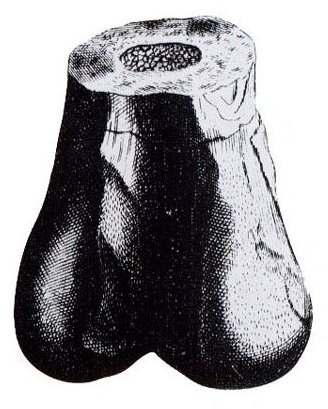
Megalosaurus is one of those classic dinosaur names that encompass the schoolboy ideal of how dinosaurs have long been regarded by the public; -‘saurus’ suggests reptilian and ‘mega’ pertains to both great size and awe.  The name literally means great lizard.  What is less widely known is that this was the first dinosaur to be described – nearly 200 years before Richard Owen thought up the term.  In 1676, Robert Plot, first curator of Oxford’s Ashmolean Museum described a fragment of leg bone (femur) too large to have come from any living British species, concluding rather that it had belonged to a giant.  This fragment was next described in 1763 by physician and author Richard Brookes, who named it “Scrotum humanum” due to its resemblance to a petrified pair of testicles. The fossil itself has been lost but the drawing of it is sufficiently detailed that it has been identified as coming from a Megalosaurus.


More fragments were discovered in Oxfordshire during the early 19th century and were acquired by William Buckland, professor of geology and Dean of Christchurch College, Oxford.  Buckland was an eccentric character who, when he wasn’t naming new species spent much of his time eating known ones.  He was fond of mice on toast and kept live badgers in his college rooms.  After the French comparative anatomist Georges Curvier examined the remains and concluded they were from a reptile, Buckland described them in 1924, giving them the name Megalosaurus.  Two years later, geologist Gideon Mantell, who first discovered Iguanodon, gave it the two-part scientific name Megalosaurus Bucklandii in honour of its discoverer.


With the naming of Iguanodon in 1825 and the discovery of large marine creatures in locations such as Lime Regis, the notion of an age of reptiles before mammals quickly gained scientific credence.  Yet it would several more decades until it caught the popular imagination.  The next major step occurred when Richard Owen collected the giant terrestrial reptiles under the term Dinosauria; terrible lizards.  This was followed by engravings of ferocious Megalosaurus snacking on rhinoceros-like Iguanodon, regardless of the fact that the two species were separated by some 40 million years.  Megalosaurus had arrived!

The first dino-mania hit Britain in 1853, whilst the Crystal Palace was being prepared for its opening in Sydenham.  In the months preceding the opening, great interest grew around the life-sized models of extinct animals, which were the first of their kind.  Inspired by Richard Owen’s monographs and constructed by Benjamin Waterhouse-Hawkins, the stars of Crystal Palace are the three species of dinosaur; Iguanodon, the spiny Hylaeosaurus and Megalosaurus.  Although unfinished when the Sydenham Crystal Palace opened June 1854, the models were a sensation. They were accompanied by an array of merchandise, including guidebooks written by Owen, small-scale models and engraved prints and posters. They also featured in satirical cartoons, many suggesting that these ‘monsters’ were more terrifying than educational.  Those involved in making them believed the models would be an aid to geology and palaeontology. Others agreed, with The Crystal Palace Herald reporting that the models were: ‘A great visual idea, of much importance to scientific instruction, this portion of the Great Exhibition will be second to none’.

Off the back of this success, Megalosaurus gained the accolade of being the first dinosaur mentioned in a work of fiction.  In the beginning of Bleak House, Charles Dickens, describing the muddy London streets, writes "Implacable November weather. As much mud in the streets as if the waters had but newly retired from the face of the earth, and it would not be wonderful to meet a Megalosaurus, forty feet long or so, waddling like an elephantine lizard up Holborn Hill."  The dinosaur has unfortunately never made it into any film or TV adaptations of the book.

In a way, the Crystal Palace Park opened at just the wrong time for Megalosaurus and its other dinosaur stars.  Up until then, dinosaur discoveries were almost entirely confined to Britain and the reconstructions were based on the highly fragmentary known remains.  During the remainder of the 19th century, new finds, many from the western United States, overturned scientific understanding of these animals.  The discovery of Hadrosaurus foulkii (one of the ‘duck-billed’ dinosaurs) in 1858 and the Bernisart Iguanodons in 1882 suggested many dinosaurs were actually bipedal, rather the four-legged behemoths Hawkins depicted.

In 1912, Megalosaurus featured in the original dinosaur adventure story, Arthur Conan Doyle’s The Lost World.  It is first glimpsed by the explorers in light of a flaming torch in the depth of night.  Conan Doyles describes the sight of “a horrible mask, like a giant toad’s, of a warty, leprous skin, and of a loose mouth all beslobbered with fresh blood.”

The Megalosaurus of The Lost World is as truly terrifying as it is implausible.  Despite numerous finds of the related Allosaurus showing these animals were bipedal, it walks on either two or four legs and resembles a monster toad, even bounding across the plateau in pursuit of its prey.  Most disturbing of all, when one is killed toward the end of the book, its heart continues to beat for days after the flesh has been carved up!

The Lost World in many respects marks the highpoint of Megalosaurus’ career in popular entertainment.  When the book was adapted for the silver screen in 1925 by Willis O’Brian, the predators were changed to Allosaurus for the benefit of American audiences.  The greatest blow to Megalosaurus’ popularity, (as well as that of most other dinosaur species) came in 1905 when Henry Fairfield Osborn published his description of a new species.  It was a huge carnivore, measuring 12 metres in length and he named it Tyrannosaurus rex.
 
In the unlikely event that you require convincing of the popularity of T. rex, consider this; it is the only organism in all of earth’s history to be widely recognised by its full scientific name.  For much of the hundred and eight years since it was discovered, it has been considered the largest terrestrial predator to have ever lived.  With this kind of prestige, its popularity was guaranteed.  IMDb lists 93 titles featuring T.rex.  Whenever dinosaurs appear on screen, you can bet there’ll be a tyrannosaur amongst them.  In comparison other individual dinosaur species have failed to capture the popular imagination in quite the in the same way.

Meanwhile the poor Megalosaurus fell into cultural and to some extent, scientific obscurity.  No other fossils of it have been accurately identified.  During the 20th century remains of carnivorous dinosaurs found in a variety of places and geological times were attributed to Megalosaurus, so the species became what is known as a taxonomic waste bin; somewhere to shove stuff you’re not sure what to do with.  Research during the late 20th century and over the last 10 years has corrected this.  The species Megalosaurus bucklandii now only refers to the fossils first described by William Buckland.  These pieces are on permanent display in Oxford’s Natural History Museum.  A fragment of skull, a section of jaw bone, some vertebra, a hip and part of a hind leg, are all we have of the first dinosaur that anyone knew about.

The Beasts of Sydenham

The Great Exhibition of 1851 was a phenomenal success.  In the five and a half months that it was open to the public, an estimated six million visitors passed through the doors of the Crystal Palace as the exhibition building became known – and at a time when the population of England and Wales was not quite 18 million.  But what to do with the building once the doors had closed? Suggestions ranged from simply leaving it in situ to the more outlandish scheme of rebuilding it as a tower.

Sir Joseph Paxton, the building’s architect, set up the Crystal Palace Company with the aim of moving the building from Hyde Park in central London to Penge Hill in Sydenham. The newly constructed Crystal Palace boasted 50 per cent more floor space than its predecessor and it was filled with courts representing different cultures and time periods. It was conceived as an ’illustrated encyclopaedia’ through which visitors could progress from one subject to the next. This notion of physical space as a means of presenting information was also applied to the large shield-shaped park laid out below the palace. It was here that the artist and sculptor Benjamin Waterhouse Hawkins decided to attempt something new. Inspired by Richard Owen’s monographs on the extinct giant reptiles of the Mesozoic era, he felt compelled to create a series of large sculptures of extinct creatures for public display.

Hawkins drew concepts for each of the animals, based on the published work of Owen and others. Satisfied with the designs, he created scaled-down clay models, which were refined to meet Owen’s standards, based on the available scientific knowledge of the time. Hawkins then made life-size clay models, from which metal casts were produced. The larger models, such as the Iguanodon, were built in situ (near the lowest lake in the park),,by pouring concrete into moulds surrounding foundations of steel and brick. Even before they were unveiled, the reconstructions were being discussed and speculated over. The Illustrated Crystal Palace Gazette reported ‘The grounds adjoining to the new road from the Rock Hills Sydenham to Penge… is the site being prepared, in hollow basin, mounds, and upheaved tumulae, for the representatives of the antediluvian world.’

This term ‘antediluvian’ refers to the biblical Great flood. One popular belief was that the extinct animals had been killed in the flood and it was even suggested that the dinosaurs’ demise was due to their being too large to fit in Noah’s ark. This, of course, wasn’t the accepted scientific theory, but it was the one presented in newspapers at the time. Another view was that these creatures were ‘the inhabitants of this earth before the abode of our first parent Adam’.

Speculation about the models came to a head on New Year’s Eve 1853, when Hawkins held a banquet at Crystal Palace Park. The table and chairs were set inside the mould used to make the standing Iguanodon, (and not inside the model itself as the famous Punch cartoon suggests). The guests included the leading scientists of the day, with Richard Owen, in his only recorded visit to the park, seated at the head of the table.

Although unfinished when the Sydenham Crystal Palace was opened by Queen Victoria in June 1854, the Geological Illustrations, to give them their official name, were a sensation and a major part of the unique experience of the park. The models were accompanied by an array of merchandise, including guidebooks written by Owen, small-scale models and engraved prints and posters. They also featured in satirical cartoons, many suggesting that the ‘antediluvian monsters’ were more terrifying than illuminating.  Those involved with the project believed that the experiment in visualising extinct animals would significantly further the causes of geology and palaeontology, among the other natural sciences. Others agreed, with The Crystal Palace Herald reporting that the models were: ‘A great visual idea, of much importance to scientific instruction, this portion of the Great Exhibition will be second to none’. Hawkins thought that children in particular responded to tangible things rather than to abstract words. He summed up the driving idea behind the Crystal Palace as being ‘one vast and combined experiment of visual education’.

On opening, the set of completed models on display comprised of Anoplotherium, Dicynodon, Hylaeosaurus, several species of Ichthyosaurus, Iguanodon, Labyrinthodon, Megaloceros, Megalosaurus, Megatherium, Mosasaurus, Palaeotherium, Plesiosaurus, Pterodactyl and Teleosaurus. These models are the most famous result of Hawkin’s labours but the park also featured three islands, each representing a different geological formation and era of time andan ‘exposed cliff face’ showing the litho-stratigraphic order of the rock formations in which the fossilised remains were found.Both Hawkins and Owen planned to introduce more extinct animals at Sydenham: there were plans for a mastodon, mammoths and a moa. Owen even suggested including a dodo.

The relocation of the Crystal Palace failed to live up to expectations.  After the great success of the Great Exhibition, it was thought that any amount of money involved would be recouped, but Joseph Paxton wished to push the grandeur of the Sydenham palace to the extreme, seemingly regardless of the cost. From the start, the Crystal Palace Company was operating beyond its means. Relocating to Sydenham left them with a debt of £1,300,000 (equivalent to £96.5 million today) that was never recovered. The building itself was not adequately insured and when the north transept burnt down in 1866, it was never rebuilt. The Geological Illustrations consumed time and raw materials and having cost £13,729 by the middle of 1855, the company decided that the range of animals already on display was sufficient.  Despite protests and their evident popularity, the project came to a stop.  Contemporary maps of the park show the site of a mastodon that never materialised. The steel frame for a mammoth was 18 foot high when work stopped. The model would have required 50 tonnes of clay.

The financial woes of the Crystal Palace Company also explain why the models were not protected from the rigors of time, either from physical damage or the more telling advances in scientific knowledge. The discovery of Hadrosaurus in 1858 showed that this dinosaur walked upright on its hind legs. A similar conclusion was drawn for Iguanodon and Megalosaurus, confirmed in 1878 by the  discovery of near-complete Iguanodon skeletons in Bernissart, Belgium. This discovery also revealed that the dinosaur’s’ ‘horn’ was actually a thumb claw, betraying the most famous ‘mistake’ in Hawkins’s reconstructions. Subsequent discoveries would further erode the reputation of the models. When American geologist Othniel Marsh visited in 1895, he said ‘There is nothing like unto them in the heavens, or on earth, or in the waters under the earth.’ They were further discredited by Henry Woodward, Keeper of Geology at the Museum in the book Extinct Monsters, when he stated that Hawkins was ‘occupied for years in unauthorised restorations’. Woodward noted that the toad-like Labyrinthodon and Dicynodon should have been more akin to salamanders, while ’Iguanodon did not usually stand on all-fours but more frequently sat up like some huge kangaroo…’ This particular notion has since been superseded.

On the night of 30 November 1936, a fire tore through the palace, burning so brightly it was seen in eight counties. 100,000 people watched the Crystal Palace’s destruction in 1936.  Amongst them was Winston Churchill, who called it ‘the end of an era’.  By morning all that remained of Joseph Paxton’s masterpiece was red hot steel and pools of molten glass. Although the Crystal Palace Company attempted to maintain the park as a going-concern, the Trustees of the company were disbanded in 1951 and the park was given to London County Council.  With the building lost and the park very much altered, the models are the most visible evidence of the ‘experiment in visual education’ that lay at the heart of the Crystal Palace scheme. 


Today, the models are largely known for their inaccuracy. It is undeniable that they quickly became outmoded, but it is their outmodedness that now makes them so valuable.  By studying past attempts to communicate science we get our best record of contemporary understanding, and in setting their ideas about these animals literally in stone, Hawkins and Owen created a unique record of the state of scientific understanding at the time. Though our understanding has since advanced it does not make their attempt less valid. Rather, it shows that our understanding of the natural world is never definitive, but subject to change.  But equally any restoration or interpretation can be superseded.  A gallery or model can be outmoded after a few years or even sooner. There will always a requirement to review, more to discover and more to communicate to others.

Exploring The Lost World

First published in 1912, The Lost World by Arthur Conan Doyle is generally considered to be the first dinosaur story. The thrilling adventure yarn – familiar to millions – is a true landmark of popular culture. 

Initially serialised in the Strand Magazine, the story is told to us by journalist Edward Malone. In order to win the love of his fiancĂ©, Gladys Hungerford, Malone has agreed to accompany Professor Challenger on an expedition to South America to investigate tales of a plateau where dinosaurs still exist. Together with the sceptical Professor Summerlee and big game hunter Lord John Roxton, they start to find evidence to support Challenger’s theory. Accessing the isolated plateau by climbing a rock pinnacle and felling a tree to form a bridge, they become trapped when the bridge is destroyed by treacherous aids.

As Conan Doyle’s characters explore, they discover numerous prehistoric species that have survived in this isolated corner of the world. The plateau is wondrous but dangerous, roamed by vicious pterodactyls and carnivorous Megalosaurus. The explorers also discover that it is home to a tribe of natives who are at war with a species of primitive humanoid – a form of ‘missing link’ between Homo sapiens and the great apes. The explorers help the natives defeat the ape-men and in doing so win their friendship. Eventually, the chief’s son shows the explorers a way down from the plateau.

When the characters return to London to share their discovery with the scientific community, no-one believes them until they produce a young pterodactyl they have brought back. The creature quickly escapes, causing alarm, but undeniably proving their case. Hailed as heroes, they retire to Lord Roxton’s rooms where he reveals another export from the plateau: diamonds valued at £200,000. With the proceeds from these precious stones, Challenger plans to open his own museum and Summerlee retires to catalogue his fossils. Malone (rejected by Gladys, who has married a solicitor in his absence) and Roxton plan a return expedition to the lost world.

Arthur Conan Doyle had broad-ranging interests: alongside his keen advocacy of spiritualism, he was interested in judicial reform, criminology and palaeontology. His home, Windlesham in Crowborough, East Sussex, was on the Weald – an area of rock formations that date back to the Upper Jurassic (145.5–150.8 million years ago). This contributed to the author’s fascination with prehistoric life and, in the spring of 1909, he wrote to the Natural History Museum requesting an expert come and view what appeared to be Iguanodon tracks found at a nearby quarry. Conan Doyle hand-drew the tracks in his letter and the discovery directly inspired a passage in The Lost World, where the first evidence of Iguanodon on the plateau also takes the form of footprints.

In November 1911, Conan Doyle wrote again to Arthur Smith Woodward, the Museum’s keeper of Geology reporting that ‘we have something in the old quarry that is beyond me’. He claimed that this mysterious object was ‘not an impression but a body’. However, when geologist Charles Dawson was dispatched to examine it, the body proved to be a ‘mere concretion of oxide of iron and sand’. The experts perhaps viewed him as a happy amateur, but Conan Doyle persisted in his hope of finding extinct reptiles in some state other than fossilised. In September 1922, he wrote to Smith Woodward stating he had seen an ichthyosaurus in the Aegean Sea.

Conan Doyle started The Lost World in October 1911 and, for details of the prehistoric life, he referred to Extinct Animals by E Ray Lankester, then Director of the Natural History Museum. This book, described by its author as ‘[nothing] more ambitious than attempt to excite in young people an interest in a most fascinating study’, contained illustrations and descriptions of many species Conan Doyle included in his adventure. However, he interpreted some of the science in peculiar ways. In Extinct Animals an image of an ichthyosaurus skull shows the parietal foramen, a hole which in modern reptiles contains a photoreceptive organ call the parietal eye. The Ichthyosaurus in The Lost World has a visible third eye on top of its head. Also, despite a clear description in Extinct Animals of Megalosaurus as bipedal, Conan Doyle’s animal walks on either two or four legs and resembles a horrible toad.

Conan Doyle may well have been inspired by the model dinosaurs at Crystal Palace Park, opened in 1854. The reconstructions, including a quadruped Megolosaurus, were already deemed obsolete by the 1900s. Like the fictional plateau, the exhibition in Sydenham featured a mixture of species from different time periods, all apparently living together around a lake. From Jurassic and Cretaceous dinosaurs to the much more recent Toxodon and Irish elk, almost all of the species at Crystal Palace appear in Conan Doyle’s book.

Conan Doyle also took an interest in exploration. In 1909 he spoke at a luncheon for Ernest Shackleton and later appeared with Robert Falcon Scott at a fundraiser for the British Antarctic Expedition. The following May he jovially admonishing American explorer Robert Peary for making the job of storytelling much harder. Previously it had been possible to write about remote parts of the world without fear of contradiction. Now that so much of the world had been explored, he asked where ‘the romance-writer is to turn when he wants to draw any vague and not too clearly-defined region’.

The answer apparently lay in the Amazon Basin. At a time when the border between Brazil and Bolivia was poorly defined, Conan Doyle’s close friend Percy Harrison Fawcett led the Bolivian Boundary Commission, tasked with preventing border disputes. When Fawcett returned to England, he brought with him tales of the Huanchaca Plateau and an impenetrable jungle where anything could be hiding.

Conan Doyle knew that exploration had led to the expansion of the British Empire, through the acquisition of new territories. He also recognised that the Empire required defence. Covering a quarter of the globe, and home to 285 million people, it was difficult and expensive to police. Britain’s small professional army was surrounded by the larger, conscripted, armies of her European neighbours: old enemies like France and Russia, and a more recent concern – Germany. The less than glorious victory of the Boer War led to genuine fears that a future conflict might lose Britain her colonies or even her independence. These worries were countered by a brash imperialism that permeated middle and upper classes British culture. In 1907, Robert Baden-Powell set up the Scout Movement to promote health, exercise and teamwork in boys. There wasn’t an implicit military connection, but he stated that they should ‘be a brick’ in the ‘wall of Empire’.

In the years preceding The Lost World, Conan Doyle wrote several Roman-era short stories, as allegories for contemporary British issues. The Last Galley was a fable about Britain’s naval superiority in the face of expanding German sea power. The Lost World’s brash imperialism is evident the admiration heaped on Roxton’s military skills and in the plot’s focus on British explorers aiding natives in defending their territory against an inhuman aggressor. Malone enthuses that, following his adventures on the plateau, he should receive a commission as correspondent in the next Great War.

The Lost World was adapted into a film in 1925 by American film-maker Willis O’Brian, using stop-motion effects to realise the dinosaurs. The movie reduces the book’s militaristic tone by adding a female character to the party and many subsequent adaptations have followed suit, overlooking Edwardian social conventions to add romance to the story. The 1925 movie also removes the conflict between the natives and ape-men, while the belligerent presence on the plateau is reduced to an actor in an ape costume and a chimpanzee. Even the treachery that traps the explorers is replaced by a brontosaurus feeding on the felled tree. Perhaps, after the First World War, the book’s soldierly fervour was considered inappropriate for cinema audiences.

By downplaying the battles between humans and ape-men, the story is refocused on exploration and scientific discovery. Although the original text is arguably diluted, the most exciting element is retained, and even magnified. The notion of an isolated place where prehistoric animals continue to thrive was first explored in Jules Verne’s Journey to the Centre of the Earth, but Conan Doyle was the first novelist to make this a central premise of his work, thus creating the archetypal dinosaur narrative. The narrative has reoccurred frequently since 1912, with tales in which people discover some remote location inhabited by creatures long thought to be extinct, become trapped and must endeavour to escape.  Jurassic Park is essentially The Lost World combined with a fear of modern technology.  At its core is the thrill of the unknown and this tale is an adventure that audiences of all ages can enjoy. As its author stated:
I have wrought my simple plan
If I give one hour of joy
To the boy who’s half a man,
Or the man who’s half a boy.

Tuesday, 27 September 2011

Isn’t it about time dinosaurs learnt how to behave?

You’ve never seen a dinosaur.  More specifically, you’ve never seen one without it first being tempered by human interpretation.  The species commonly considered as dinosaurs became extinct 65 million years ago at the end of the Mesozoic era, a period in Earth’s history spanning 250 million years.  Since the early nineteenth century when fossils of extinct marine and land reptiles began to be unearthed and studied, every image of them has been a reconstruction based on the physical evidence – fossilized bones, teeth, claws and feathers.  This process of reconstructing extinct animals from somewhat limited evidence inevitably requires a lot of input from the human imagination.  This raises some important questions of what these animals really looked like and what they really did.

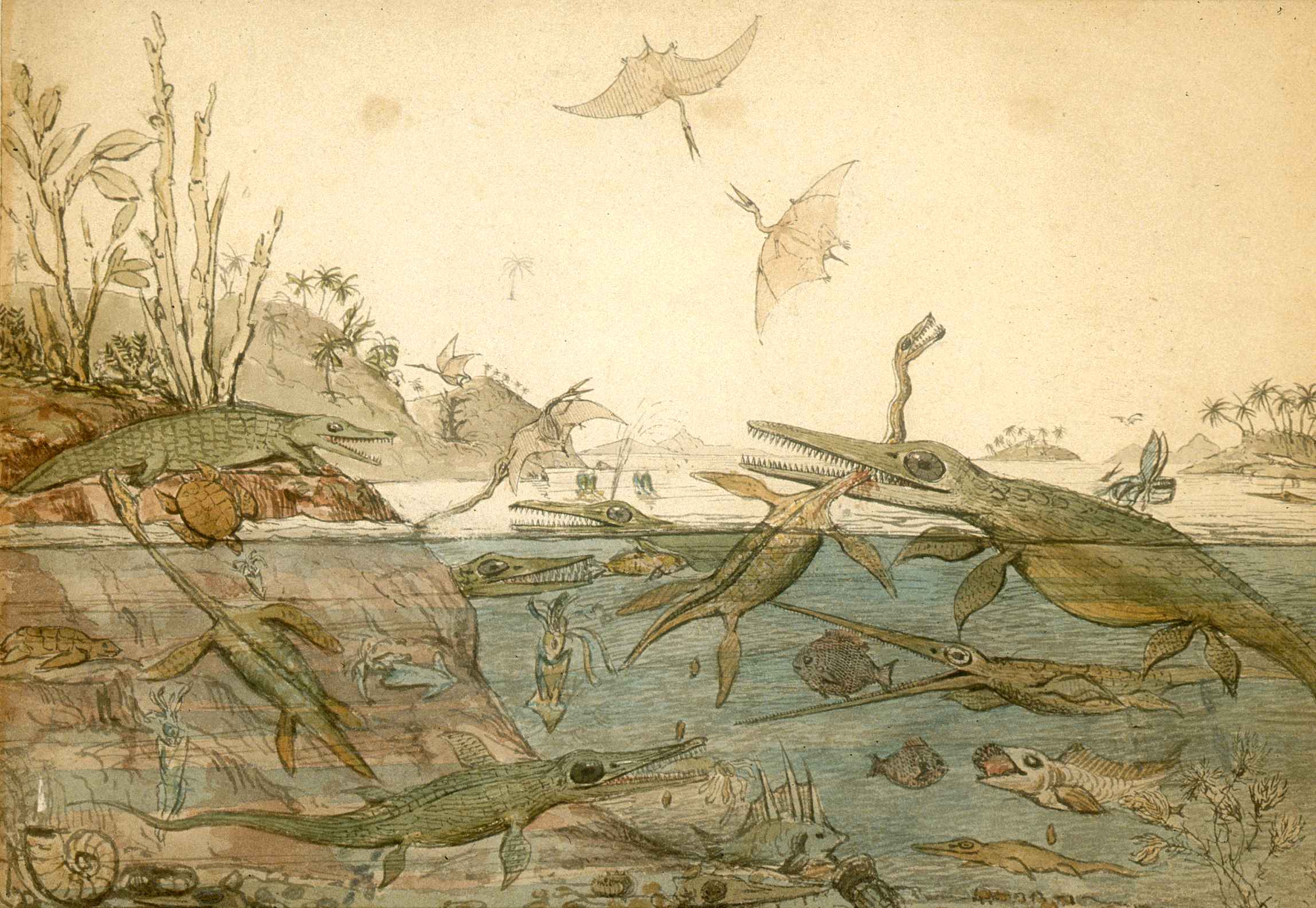
In the mid nineteenth century artists rushed to illustrate the newly conceptualised dinosaur world for a public gripped by the original dino-mania.  The results, produced by the likes of John Martin (1789 – 1854) and Henry de la Beche (1796 – 1855) are certainly dramatic, but do not fare well in the light of hindsight.  Working from descriptions of incomplete fossil skeletons and with little knowledge of comparative anatomy, (applying the rules of how the bodies work and fit together in living animals to extinct ones), the images are embarrassingly inaccurate.  Famously, the first reconstructions of the herbivore Iguanodon produced an elephantine quadruped with a prominent nasal horn.  More significant however is that, with a typically Victorian sense of melodrama, the pictures show a nightmare world in which every animal is both eating and being eaten by another animal, like some murderous game of Twister.  There was no real attempt to represent realistic behaviour, just the desire to show these extinct creatures in the most sensational light.  The dinosaur world was portrayed as nature at its most ‘red in tooth and claw’.
Since this time the rate of discovery in the field of palaeontology has maintained a rapid pace, with the exception the period of the world wars.  New fossils constantly add to or over haul our understanding of dinosaurs.  In 1882, the first complete skeletons of Iguanodon were restored from finds in Bernissart, Belgium.  Unfortunately these reconstructions portrayed the animal as strictly bipedal, like a sort of reptilian kangaroo.  The horn was moved to its correct position on the forelimbs, but the arms were held in a permanent thumbs-up position, like a prehistoric Henry Winkler.
An even more significant find had been made twenty-one years earlier.  Discovered in a limestone quarry in 1860, Archaeopteryx was seized upon as clear evidence to support the theory of evolution.  With its mixture of dinosaur and bird characteristics, its smoking gun evidence that birds evolved from bipedal carnivorous dinosaurs.  Dinosaurs could now be understood, not as a biological anomaly, but as part of the ongoing process of evolution leading to the modern world.  The idea that dinosaurs evolved into birds or that birds are dinosaurs or however you want to put it has only fairly recently established itself in popular culture, due in part to being rejected in 1926 by Danish palaeontologist Gerhard Heilmann.  As the bone beds of Africa and North America began to be excavated, the dinosaurs found seemed to illustrate how unlike these creatures were to living animals in their sheer size and arrays of horns and crests.  The popular image of dinosaurs became that of impossibly huge sluggish reptiles that dragged their heavy tails behind them and had tiny brains.  This view was applied to all well-known species of dinosaurs, forming a picture of a world in slow motion, whose inhabitants had probably succumbed to extinction through stupidity - if not stupidity, then definitely due to being inferior to warm-blooded mammals.
 In 1914, the animated Gertie the Dinosaur became the first film to introduce dinosaurs to cinema.   Never intended as science, the comical Gertie is a Diplodocus (or maybe Apatosaurus) who waddles towards camera, hoovering up whole trees and even throwing a woolly mammoth into the sea with a flick of her long neck.   For nearly 80 years movies would reinforce the view of dinosaurs as waddling, dim-witted giants and particularly violent ones at that, with carnivorous dinosaurs always there to fight humans, other dinosaurs and giant gorillas.  The stories and the limit of special effects meant that, generally speaking dinosaurs appeared in small numbers and with a preference for menacing, (i.e. eating) their human co-stars.  Once again the view is of dinosaurs as monsters, not animals acting out natural behaviours.
It was the late 1960s by the time this view was challenged.  In what has come to be known as the dinosaur renaissance, scientists began to reassess every aspect of dinosaurs, including anatomy, evolution and behaviour.  Perhaps the most significant new specie in this renaissance was a three metre long, lightly built carnivore with a sickle-shaped claw on the second toe of each foot.  First discovered in 1964, Deinonychus firmly re-established that birds originated from dinosaurs and showed that small carnivorous dinosaurs, (dromeosaurs), shared many features with birds, such as hollow bones and similar shaped bones in the pelvis and wrists.  It also implied that dinosaurs might have metabolisms closer to warm-blooded birds and mammals than cold-blooded reptiles.
The other remarkable thing about Deinonychus was that the evidence suggested it may have hunted in packs.  While herbivores like Stegosaurus or Diplodocus can get by with low intelligence, hunting in packs requires the ability to learn strategies, communicate and understand the pecking order.  It requires intelligence.  This meant that at least some dinosaurs were reasonably intelligent and therefore would have been behaviourally complex.
This sea change in thinking about dinosaurs inevitably took some time to reach popular cultural depictions of dinosaurs.  The film that made that breakthrough was of course Jurassic Park in 1993.  The film has plenty of scientific inaccuracies, some imported from the original Michael Crichton novel and some of its own doing.  Nonetheless, in general terms the dinosaurs are accurate and they look like real animals, due to the ground breaking computer-generated effects.  Less obvious, but equally important is the fact they sound like real animals.  Rather than a simplistic “pre-recorded roar#1”, the dinosaurs make distinct and varied noises, particularly the Velociraptors.  Jurassic Park also introduced into the mainstream the concept that it wasn’t just the giant dinosaurs that were exciting, smaller ones were could be as fascinating, arguably paving the way for more holistic depictions of Mesozoic wildlife.
The CGI used in Jurassic Park and in every effects movie since meant it was much easier to portray groups of dinosaurs – as Sam Neill intones, “They do move in herds.”  Unfortunately, from a behavioural standpoint, the film still errs on the side of monstrosity.   Fair enough, in a film with a remit of pure adventure.  Still, the predatory dinosaurs pursue the people with a murderous relentlessness, ignoring boundaries of territory and the abundance of dinosaur prey available.  Another trait common to carnivore dinosaurs, it would appear, was the habit of issuing a roar or snarl to warn their intended prey that they’re about to attack, thus increasing the quarry’s chances of survival.
In 1999, the logical next step in popular culture dino-mania occurred.  The BBC’s Walking with Dinosaurs ambitiously attempted to make a wildlife documentary showing the lives of dinosaurs, focusing on them as living animals rather than extinct fossils.  This six part series, spanning the whole Mesozoic era showcased a range of species, including dinosaurs, flying pterosaurs and marine reptiles.  It may have been highly conjectural, but it examined a range of behaviour never seen before in dinosaurs, with them giving birth, eating, marking territory, pooing, farting and mating all over the show.  Walking with Dinosaurs remains a high-water mark in dinosaur documentaries.  Yet there is one small niggle, aside from Kenny Branagh’s “wooorld of the DIIINOOOSAAURS!” narration style.  The final episode, ‘Death of a Dynasty’ focuses on a female Tyrannosaurus rex and at times the mask of science seems to slip.  The T.rex spends a large portion of the time stomping around, knocking things over with its tail, roaring and spraying phlegm at the camera.  It’s as if the programme makers felt obliged to have this most famous of dinosaurs showboat for the audience.
In the wake of Walking with Dinosaurs has come a raft of imitations, often using bargain bucket effects.  These documentaries tend to focus on predatory dinosaurs and present them in the most melodramatic terms.  Particularly in the case of recent discoveries, there tends to be the assertion that this dinosaur was the most terrifying ever, as if amount of terror induced is a quantifiable attribute, (it isn’t).  Although these documentaries are based on actual paleontological research, often in conjunction with academic centres, it is the most dramatic, violent interpretation of the evidence that is presented.  Along with reconstructions that give the dinosaurs garish coloration and needle sharp teeth and claws, the preoccupation with hunting and fighting results in a CGI version of the early artworks of Martin and de le Beche – based on current thinking but designed to make the dinosaurs seem as terrible, strange and blood-thirsty as possible.
In the last couple of decades, museums got in on the act, using life-size animatronic puppetry to reconstruct dinosaurs in galleries where mounted skeletons and miniatures were once the closest visitors could come to ‘real’ dinosaurs.  While they may pull in the crowds, animatronics are rather ineffective in their ability to address issues of behaviour.  They can’t walk and so they tend to be limited to roaring and trashing about on the spot for hours on end.  Honestly, if a lion was seen doing that in a zoo, it would raise some pretty serious questions about its well-being.
We now know more about dinosaurs than at any time in history.  Fossil-hunting in previously untapped locations is turning up new species and new information on dinosaurs as a whole.  New technology is extracting new information from old finds.  Dinosaurs have an indelible prominence in popular culture, particularly with children.  Yet, in regards to what we expect dinosaurs to do, we haven’t moved so very far from those early depictions and those conga lines of biting, clawing, writhing reptiles.
There appears to be an underlying desire to view dinosaurs as terrifying, as monsters and there may be a cultural explanation.  If, in the thrashing animatronic T.rex and poorly rendered dromeosaurs we can still detect the dragons and sea monsters of legend, it is because they have had those qualities projected on to them.  If dinosaur remains inspired the stories of mythical beasts, as has been argued, then perhaps they have become stand-ins for creatures we generally accept did not exist.  They perform the cultural function of the monsters that excite and frighten, but are conveniently separated from use by a vast gulf of time.  Yet this is a potential cul-de-sac to our understanding dinosaurs as living animals.  Hunting and combat are always going to be the most immediately exciting elements of behaviour, but they make up quite a small proportion of an animal’s lifetime.  A lion spends 22 hours a day resting.  Admittedly sleeping dinosaurs aren’t going to make great viewing, (although there are could be some interesting scientific questions relating to it) but if all the roaring and biting can be tempered with other behaviour, if we can hang onto the fact they were animals and not monsters, then we might even learn something.