Showing posts with label london. Show all posts

Wednesday, 11 December 2013

Megalosaurus – the rise and fall of the first dinosaur super star

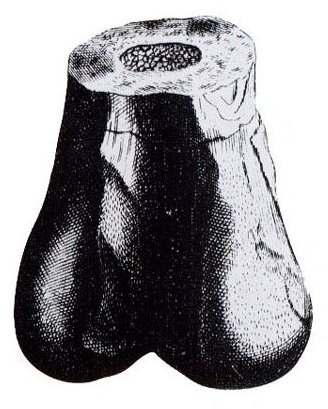
Megalosaurus is one of those classic dinosaur names that encompass the schoolboy ideal of how dinosaurs have long been regarded by the public; -‘saurus’ suggests reptilian and ‘mega’ pertains to both great size and awe.  The name literally means great lizard.  What is less widely known is that this was the first dinosaur to be described – nearly 200 years before Richard Owen thought up the term.  In 1676, Robert Plot, first curator of Oxford’s Ashmolean Museum described a fragment of leg bone (femur) too large to have come from any living British species, concluding rather that it had belonged to a giant.  This fragment was next described in 1763 by physician and author Richard Brookes, who named it “Scrotum humanum” due to its resemblance to a petrified pair of testicles. The fossil itself has been lost but the drawing of it is sufficiently detailed that it has been identified as coming from a Megalosaurus.


More fragments were discovered in Oxfordshire during the early 19th century and were acquired by William Buckland, professor of geology and Dean of Christchurch College, Oxford.  Buckland was an eccentric character who, when he wasn’t naming new species spent much of his time eating known ones.  He was fond of mice on toast and kept live badgers in his college rooms.  After the French comparative anatomist Georges Curvier examined the remains and concluded they were from a reptile, Buckland described them in 1924, giving them the name Megalosaurus.  Two years later, geologist Gideon Mantell, who first discovered Iguanodon, gave it the two-part scientific name Megalosaurus Bucklandii in honour of its discoverer.


With the naming of Iguanodon in 1825 and the discovery of large marine creatures in locations such as Lime Regis, the notion of an age of reptiles before mammals quickly gained scientific credence.  Yet it would several more decades until it caught the popular imagination.  The next major step occurred when Richard Owen collected the giant terrestrial reptiles under the term Dinosauria; terrible lizards.  This was followed by engravings of ferocious Megalosaurus snacking on rhinoceros-like Iguanodon, regardless of the fact that the two species were separated by some 40 million years.  Megalosaurus had arrived!

The first dino-mania hit Britain in 1853, whilst the Crystal Palace was being prepared for its opening in Sydenham.  In the months preceding the opening, great interest grew around the life-sized models of extinct animals, which were the first of their kind.  Inspired by Richard Owen’s monographs and constructed by Benjamin Waterhouse-Hawkins, the stars of Crystal Palace are the three species of dinosaur; Iguanodon, the spiny Hylaeosaurus and Megalosaurus.  Although unfinished when the Sydenham Crystal Palace opened June 1854, the models were a sensation. They were accompanied by an array of merchandise, including guidebooks written by Owen, small-scale models and engraved prints and posters. They also featured in satirical cartoons, many suggesting that these ‘monsters’ were more terrifying than educational.  Those involved in making them believed the models would be an aid to geology and palaeontology. Others agreed, with The Crystal Palace Herald reporting that the models were: ‘A great visual idea, of much importance to scientific instruction, this portion of the Great Exhibition will be second to none’.

Off the back of this success, Megalosaurus gained the accolade of being the first dinosaur mentioned in a work of fiction.  In the beginning of Bleak House, Charles Dickens, describing the muddy London streets, writes "Implacable November weather. As much mud in the streets as if the waters had but newly retired from the face of the earth, and it would not be wonderful to meet a Megalosaurus, forty feet long or so, waddling like an elephantine lizard up Holborn Hill."  The dinosaur has unfortunately never made it into any film or TV adaptations of the book.

In a way, the Crystal Palace Park opened at just the wrong time for Megalosaurus and its other dinosaur stars.  Up until then, dinosaur discoveries were almost entirely confined to Britain and the reconstructions were based on the highly fragmentary known remains.  During the remainder of the 19th century, new finds, many from the western United States, overturned scientific understanding of these animals.  The discovery of Hadrosaurus foulkii (one of the ‘duck-billed’ dinosaurs) in 1858 and the Bernisart Iguanodons in 1882 suggested many dinosaurs were actually bipedal, rather the four-legged behemoths Hawkins depicted.

In 1912, Megalosaurus featured in the original dinosaur adventure story, Arthur Conan Doyle’s The Lost World.  It is first glimpsed by the explorers in light of a flaming torch in the depth of night.  Conan Doyles describes the sight of “a horrible mask, like a giant toad’s, of a warty, leprous skin, and of a loose mouth all beslobbered with fresh blood.”

The Megalosaurus of The Lost World is as truly terrifying as it is implausible.  Despite numerous finds of the related Allosaurus showing these animals were bipedal, it walks on either two or four legs and resembles a monster toad, even bounding across the plateau in pursuit of its prey.  Most disturbing of all, when one is killed toward the end of the book, its heart continues to beat for days after the flesh has been carved up!

The Lost World in many respects marks the highpoint of Megalosaurus’ career in popular entertainment.  When the book was adapted for the silver screen in 1925 by Willis O’Brian, the predators were changed to Allosaurus for the benefit of American audiences.  The greatest blow to Megalosaurus’ popularity, (as well as that of most other dinosaur species) came in 1905 when Henry Fairfield Osborn published his description of a new species.  It was a huge carnivore, measuring 12 metres in length and he named it Tyrannosaurus rex.
 
In the unlikely event that you require convincing of the popularity of T. rex, consider this; it is the only organism in all of earth’s history to be widely recognised by its full scientific name.  For much of the hundred and eight years since it was discovered, it has been considered the largest terrestrial predator to have ever lived.  With this kind of prestige, its popularity was guaranteed.  IMDb lists 93 titles featuring T.rex.  Whenever dinosaurs appear on screen, you can bet there’ll be a tyrannosaur amongst them.  In comparison other individual dinosaur species have failed to capture the popular imagination in quite the in the same way.

Meanwhile the poor Megalosaurus fell into cultural and to some extent, scientific obscurity.  No other fossils of it have been accurately identified.  During the 20th century remains of carnivorous dinosaurs found in a variety of places and geological times were attributed to Megalosaurus, so the species became what is known as a taxonomic waste bin; somewhere to shove stuff you’re not sure what to do with.  Research during the late 20th century and over the last 10 years has corrected this.  The species Megalosaurus bucklandii now only refers to the fossils first described by William Buckland.  These pieces are on permanent display in Oxford’s Natural History Museum.  A fragment of skull, a section of jaw bone, some vertebra, a hip and part of a hind leg, are all we have of the first dinosaur that anyone knew about.

The Beasts of Sydenham

The Great Exhibition of 1851 was a phenomenal success.  In the five and a half months that it was open to the public, an estimated six million visitors passed through the doors of the Crystal Palace as the exhibition building became known – and at a time when the population of England and Wales was not quite 18 million.  But what to do with the building once the doors had closed? Suggestions ranged from simply leaving it in situ to the more outlandish scheme of rebuilding it as a tower.

Sir Joseph Paxton, the building’s architect, set up the Crystal Palace Company with the aim of moving the building from Hyde Park in central London to Penge Hill in Sydenham. The newly constructed Crystal Palace boasted 50 per cent more floor space than its predecessor and it was filled with courts representing different cultures and time periods. It was conceived as an ’illustrated encyclopaedia’ through which visitors could progress from one subject to the next. This notion of physical space as a means of presenting information was also applied to the large shield-shaped park laid out below the palace. It was here that the artist and sculptor Benjamin Waterhouse Hawkins decided to attempt something new. Inspired by Richard Owen’s monographs on the extinct giant reptiles of the Mesozoic era, he felt compelled to create a series of large sculptures of extinct creatures for public display.

Hawkins drew concepts for each of the animals, based on the published work of Owen and others. Satisfied with the designs, he created scaled-down clay models, which were refined to meet Owen’s standards, based on the available scientific knowledge of the time. Hawkins then made life-size clay models, from which metal casts were produced. The larger models, such as the Iguanodon, were built in situ (near the lowest lake in the park),,by pouring concrete into moulds surrounding foundations of steel and brick. Even before they were unveiled, the reconstructions were being discussed and speculated over. The Illustrated Crystal Palace Gazette reported ‘The grounds adjoining to the new road from the Rock Hills Sydenham to Penge… is the site being prepared, in hollow basin, mounds, and upheaved tumulae, for the representatives of the antediluvian world.’

This term ‘antediluvian’ refers to the biblical Great flood. One popular belief was that the extinct animals had been killed in the flood and it was even suggested that the dinosaurs’ demise was due to their being too large to fit in Noah’s ark. This, of course, wasn’t the accepted scientific theory, but it was the one presented in newspapers at the time. Another view was that these creatures were ‘the inhabitants of this earth before the abode of our first parent Adam’.

Speculation about the models came to a head on New Year’s Eve 1853, when Hawkins held a banquet at Crystal Palace Park. The table and chairs were set inside the mould used to make the standing Iguanodon, (and not inside the model itself as the famous Punch cartoon suggests). The guests included the leading scientists of the day, with Richard Owen, in his only recorded visit to the park, seated at the head of the table.

Although unfinished when the Sydenham Crystal Palace was opened by Queen Victoria in June 1854, the Geological Illustrations, to give them their official name, were a sensation and a major part of the unique experience of the park. The models were accompanied by an array of merchandise, including guidebooks written by Owen, small-scale models and engraved prints and posters. They also featured in satirical cartoons, many suggesting that the ‘antediluvian monsters’ were more terrifying than illuminating.  Those involved with the project believed that the experiment in visualising extinct animals would significantly further the causes of geology and palaeontology, among the other natural sciences. Others agreed, with The Crystal Palace Herald reporting that the models were: ‘A great visual idea, of much importance to scientific instruction, this portion of the Great Exhibition will be second to none’. Hawkins thought that children in particular responded to tangible things rather than to abstract words. He summed up the driving idea behind the Crystal Palace as being ‘one vast and combined experiment of visual education’.

On opening, the set of completed models on display comprised of Anoplotherium, Dicynodon, Hylaeosaurus, several species of Ichthyosaurus, Iguanodon, Labyrinthodon, Megaloceros, Megalosaurus, Megatherium, Mosasaurus, Palaeotherium, Plesiosaurus, Pterodactyl and Teleosaurus. These models are the most famous result of Hawkin’s labours but the park also featured three islands, each representing a different geological formation and era of time andan ‘exposed cliff face’ showing the litho-stratigraphic order of the rock formations in which the fossilised remains were found.Both Hawkins and Owen planned to introduce more extinct animals at Sydenham: there were plans for a mastodon, mammoths and a moa. Owen even suggested including a dodo.

The relocation of the Crystal Palace failed to live up to expectations.  After the great success of the Great Exhibition, it was thought that any amount of money involved would be recouped, but Joseph Paxton wished to push the grandeur of the Sydenham palace to the extreme, seemingly regardless of the cost. From the start, the Crystal Palace Company was operating beyond its means. Relocating to Sydenham left them with a debt of £1,300,000 (equivalent to £96.5 million today) that was never recovered. The building itself was not adequately insured and when the north transept burnt down in 1866, it was never rebuilt. The Geological Illustrations consumed time and raw materials and having cost £13,729 by the middle of 1855, the company decided that the range of animals already on display was sufficient.  Despite protests and their evident popularity, the project came to a stop.  Contemporary maps of the park show the site of a mastodon that never materialised. The steel frame for a mammoth was 18 foot high when work stopped. The model would have required 50 tonnes of clay.

The financial woes of the Crystal Palace Company also explain why the models were not protected from the rigors of time, either from physical damage or the more telling advances in scientific knowledge. The discovery of Hadrosaurus in 1858 showed that this dinosaur walked upright on its hind legs. A similar conclusion was drawn for Iguanodon and Megalosaurus, confirmed in 1878 by the  discovery of near-complete Iguanodon skeletons in Bernissart, Belgium. This discovery also revealed that the dinosaur’s’ ‘horn’ was actually a thumb claw, betraying the most famous ‘mistake’ in Hawkins’s reconstructions. Subsequent discoveries would further erode the reputation of the models. When American geologist Othniel Marsh visited in 1895, he said ‘There is nothing like unto them in the heavens, or on earth, or in the waters under the earth.’ They were further discredited by Henry Woodward, Keeper of Geology at the Museum in the book Extinct Monsters, when he stated that Hawkins was ‘occupied for years in unauthorised restorations’. Woodward noted that the toad-like Labyrinthodon and Dicynodon should have been more akin to salamanders, while ’Iguanodon did not usually stand on all-fours but more frequently sat up like some huge kangaroo…’ This particular notion has since been superseded.

On the night of 30 November 1936, a fire tore through the palace, burning so brightly it was seen in eight counties. 100,000 people watched the Crystal Palace’s destruction in 1936.  Amongst them was Winston Churchill, who called it ‘the end of an era’.  By morning all that remained of Joseph Paxton’s masterpiece was red hot steel and pools of molten glass. Although the Crystal Palace Company attempted to maintain the park as a going-concern, the Trustees of the company were disbanded in 1951 and the park was given to London County Council.  With the building lost and the park very much altered, the models are the most visible evidence of the ‘experiment in visual education’ that lay at the heart of the Crystal Palace scheme. 


Today, the models are largely known for their inaccuracy. It is undeniable that they quickly became outmoded, but it is their outmodedness that now makes them so valuable.  By studying past attempts to communicate science we get our best record of contemporary understanding, and in setting their ideas about these animals literally in stone, Hawkins and Owen created a unique record of the state of scientific understanding at the time. Though our understanding has since advanced it does not make their attempt less valid. Rather, it shows that our understanding of the natural world is never definitive, but subject to change.  But equally any restoration or interpretation can be superseded.  A gallery or model can be outmoded after a few years or even sooner. There will always a requirement to review, more to discover and more to communicate to others.

Thursday, 13 October 2011

The Genius of Jack Sheppard


This is John or ‘Jack’ Sheppard, born in Spitalfields, London on 4 March 1702.  Like most boys at this time, he was indentured as an apprentice to a craftsman, in this case a carpenter, named appropriately Mr. Woods.  Sheppard learnt his craft quickly and was soon idling; distracted by the various elicit enticements of London, particularly a prostitute named Elizabeth Lyon.  In order to supplement his trainee’s wages and pay for his new lifestyle, Sheppard, with help from his friends and brother, Thomas, turned to theft.

So far, this could be the story of hundreds of idle apprentices in the 1720s, but in 1723, he broke Lyon out of St Giles parish roundhouse (roughly where the Odeon Covent Garden now stands).  In February 1724 Sheppard was himself committed to the roundhouse and locked in a room on the top floor.  He cut a hole through the ceiling and climbed out onto the roof.  He got down to the ground, passed through the crowd that had gathered and got away. 

After this, Sheppard and Lyon were caught again and imprisoned in Clerkenwell New Prison.  Sheppard cut his way out of the barred window of their cell.  Making a rope from Lyon’s dress and the sheets from their bed; they climbed down into the yard of Bridewell Prison, which stood next door, before climbing over the 25 ft high gate to freedom.  From this point until the end of the year, Sheppard was the top news story in London.

In 1724 London had no police force; even the Bow Street Runners wouldn’t exist for another quarter of a century.  Aside from elderly watchmen and parish constables, the primary means for controlling crime was thief-takers.   These were private businessmen who, through contacts in the criminal underworld, arranged the return of stolen property to the original owners and also arrested suspected criminals, often informing against them.  By the 1720s, a man named Jonathan Wild had such a monopoly in the business that he adopted the title Thief-taker General of Britain and Ireland.  Egotism was hardly Wild’s only sin – his monopoly on ‘policing’ came from the fact that he was secretly in charge of London’s criminal gangs and essentially fencing stolen goods back to their owners for a fee.  His position as thief-taker allowed him to impeach any criminals who didn’t work for him (such as Sheppard) and let the law dispose of them at the gallows. Any of Wild’s own gang who stepped out of line were dealt with in a similar fashion.  Did I also mention that Wild was a bigamist, ran a brothel and had his predecessor arrested for homosexuality?

The robbery that Sheppard would be condemned for was of 118 yards of cloth and other goods to the value of not quite £50.  Sheppard was arrested, tried and sentenced to execution (the theft of goods worth more than a shilling was a capital crime, as was receiving stolen goods).  He was placed in the condemned hold of Newgate Prison.  With the aid of Lyon, he cut off one of the spikes that topped the gate into the hold, climbed over and then, disguised in a dress and bonnet, walked out of the prison.  He was recaptured about a week later and placed in the strongest room, known as the Castle.  On the evening of 15 October, he began his most remarkable escape.  With a nail, he picked the locks of his handcuff and then broke one of the links of the chain that ran between his leg irons and the floor.  He then broke a hole in the chimney breast, climbed up the chimney and, making another hole, emerged into the room above.  He broke the lock on the door, went to the prison chapel and picked the lock.  He broke through four more doors and climbed onto the roof of the prison, which spanned the street.  He then returned to his cell and retrieved his blankets.  Securing them to the side of the gatehouse, he climbed down onto the roofs of Newgate Street.  Climbing into the window of one of the houses, he crept down to street level and got away.

This escape secured Sheppard’s last stint at liberty as well as his lasting fame.  He was returned to Newgate two weeks later, loaded down with 300 lbs of chains and locks.  Despite a last minute attempt at liberation with a hidden penknife, Sheppard was taken to Tyburn on Monday 16 November 1724 and executed.  He was just 22 years old.

Following this, Wild’s power in the criminal underworld began to wane.  After a knife attack from one of his own men outside the Old Bailey courthouse, Wild was bed-ridden for several weeks.  Unable to maintain the service he had provided and with the press casting him as an ogre in his pursuit of Sheppard, doubts began to be cast on Wild’s business practises.  Then, in an outrageous move, Wild attempted to break one of his accomplices out of prison.  Wild was arrested and imprisoned in Newgate, where he attempted to continue his business.  He was tried on several accounts and eventually found guilty of receiving stolen goods.  He was executed on 24 May 1725, drugged with laudanum by himself and pelted with stones, dead animals and poo by the London mob.  That’s all 100% accu-rat.

Even before Sheppard died, likenesses and retellings of his life began to appear.  The official biographies of condemned criminals, known as The Ordinary’s Accounts, for 4 September 1724 includes ‘JOHN SHEPHERD, a notorious Thief and House Breaker (whose Life should have been inserted in this Paper, had he not made his narrow Escape from Death on Monday last’.  Sheppard’s escape from the condemned cell afforded the opportunity of a second account of his life, as well as ensuring an audience for it.  Three more lives of Sheppard appeared before the end of the year.
 
During his confinement in Newgate, Sheppard was visited by Sir James Thornhill, the royal painter to George I.  Although Thornhill’s original painting has not survived, a number of sketches and engravings remain (see above).  They show a youthful, somewhat androgynous face, dominated by wide, innocent eyes.  His large hands are a prominent feature of the portrait, as though Sheppard was an artist or architect.  He worked with his hands.

Twelve days after Sheppard’s execution, the first play based on his life, Harlequin Sheppard opened.  In 1728, a far more acclaimed play opened; John Gay’s The Beggar’s Opera.  The play is innately aware of the expanding cultural world it inhabited, making it one of the earliest post-structural works.   The play shared this awareness with its audience through references to a diverse range of cultural phenomena, such as accounts of condemned criminals.  In the characters of the highwayman Macheath and his rivalry with thief-taker Mr Peachum, the audience would have recognised Sheppard and Wild.  It did not end there either; works of fiction based on these two men’s lives would continue to appear for nearly three centuries. 

The genius of Jack Sheppard’s story is the many ways it can be reinterpreted.  In the hands of clergymen and moral guardians it served as a cautionary tale against the evils of alcohol, prostitutes and of breaking the bonds of apprenticeship.  Ballad-writers, playwrights, authors and directors over the centuries have delighted in what is an essentially exciting, romantic (with a big or little R) story.  Historians have taken it as an important social event in itself, or as an iris through which to explore Georgian London.  Sheppard has also been viewed as a libertine and an archetypal rebellious youth – James Dean in a frockcoat.  And in opposition to rebellion, naturally, is authority.  In the personage of Jonathan Wild, this authority is rife with hypocrisy, brutality and corruption.

As recently as 2009 the art installation/ film The Last Days of Jack Sheppard juxtaposed the jail-breaker’s exploits with the bankers and speculators who caused the South Sea Bubble (the first modern economic crisis, in 1720), as a barely veiled metaphor for the current world financial meltdown.  Sheppard’s story is also part of a long line of narratives, fictional and factual, in which the criminal is less villainous/ more reliable than those who claim to be upholding society’s values. 

None of this is to say John Sheppard was an unambiguous hero.  He was not.  He engaged in house breaking and theft.  He did not, despite what we might like to believe, rob from the rich to feed the poor.  Nor was he coerced into it.  He turned to crime to pay for vices that he could have rejected.  He was a genius of applied thinking, using the skills he learnt as an apprentice to enter and exit buildings almost at will.  Yet this logic seems to have deserted him when it came to fleeing the confines of London, which he only left for a week in his whole life.  On the other hand, his crimes were not violent, he was loyal to a fault and he confessed and regretted his transgressions.  So not an angel, but maybe an honest thief is preferably to a dishonest lawman.   In the dramatis personae of London in 1724, he comes out as the best and the most interesting of a bad bunch.  His story is full of thrills – it's standing on the narrow ramparts of Newgate in the moonlight, six stories above the street and halfway to freedom.  It’s breaking your lover out of jail, or being locked in with them.  It's the crooked thief-taker brought to the gallows by his own arrogance.  But there are also underlying resonances, indelible themes which will continue to resound whenever we live in a world where youth runs amok and authority is corrupt.

Would you like to know more?
Jack Sheppard on Wikipedia: http://en.wikipedia.org/wiki/Jack_Sheppard
Jack Sheppard in the Newgate Calendar http://www.exclassics.com/newgate/ng173.htm